
Visiting the Rheingau
Vineyards, castles, monasteries, the Rhine and wine - the Rheingau is simply beautiful and the "small home of the great Riesling".

If you are traveling from out of town, you should definitely combine the Rheingau Wine Week with a visit to the Rheingau. With a vineyard area of just 3,000 hectares, the Rheingau may be one of the smallest, but it is one of the most important wine-growing regions in Germany thanks to its outstanding Rieslings.
Explore the idyllic vineyards, hike the region on the "Riesling Loops" or soar above the vines on the cable cars in Rüdesheim or Assmannshausen. Here are some highlights that you shouldn't miss!


Start your day in the Rheingau with a visit to Eberbach Monastery (opens in a new tab), one of the best-preserved medieval monasteries in Europe and the filming location for the historical thriller "The Name of the Rose". Tours are offered daily from 10 am to 7 pm, Saturdays, Sundays and public holidays from 9 am to 7 pm. Tickets can be purchased online and on site at any time.
You can combine a nice little walk through the vineyards with a visit to the "Black Cottage" (opens in a new tab), which is just five minutes away from Eberbach Monastery in the middle of the vineyards and from where you have a fantastic view over the Rheingau. The wine bar is located in the traditional "Steinberg", which is considered the favorite vineyard of the Cistercians.
Opening hours:
- Open only in good weather from April to October
- Friday 3 p.m. to 7 p.m.
- Saturday, Sunday and public holidays 11 am to 7 pm
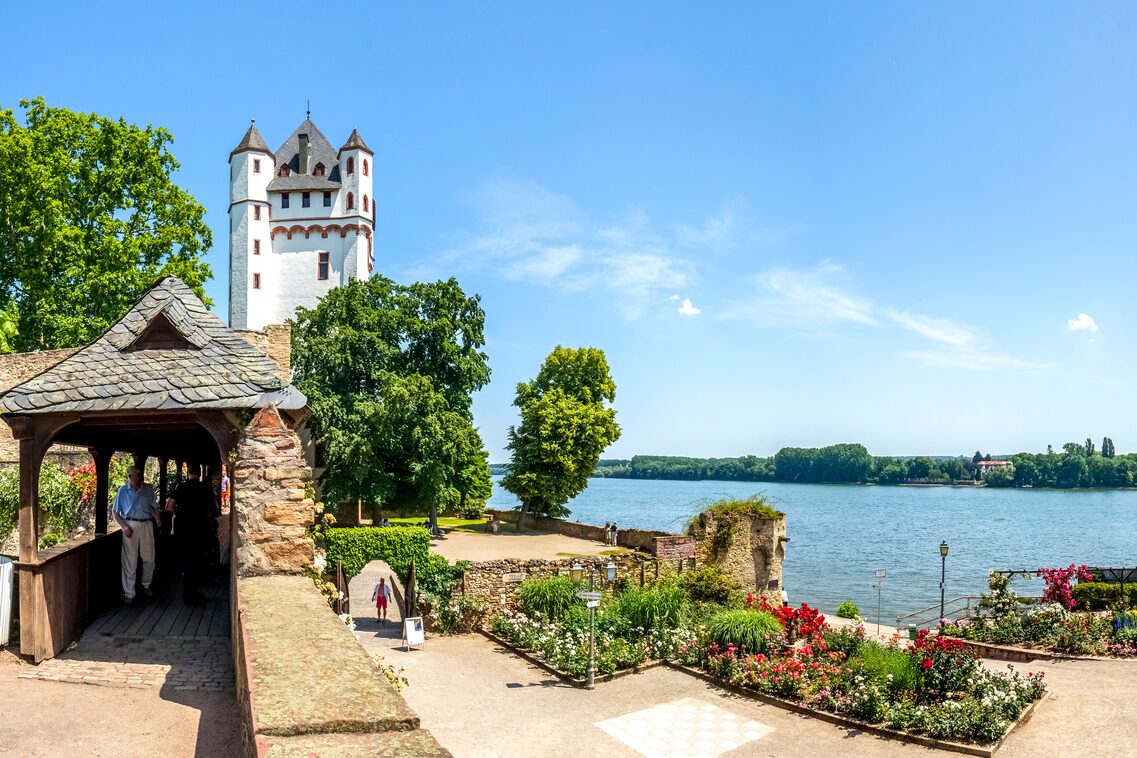
In ten minutes by car, you can reach the "rose town" of Eltville. Stroll along the promenade along the Rhine, visit the castle and stop off at one of the restaurants for lunch with a view of the water, such as "Anleger 511" (opens in a new tab).
Strengthened, you can reach another highlight in just 20 minutes - Rüdesheim, known worldwide for its "Drosselgasse". The cable car (opens in a new tab) starts in the middle of Rüdesheim and takes you over the vines to the historic Niederwald Monument. A fantastic view over the vineyards and the Rhine awaits you here! The "Walk like a local" (opens in a new tab) wine hikes are also very popular, where - equipped with a rucksack with small bottles of wine and a deck of cards - you can learn more about viticulture, the local winegrowers and the history of the Rheingau.
With so many new impressions in your luggage, you will return to Wiesbaden in just half an hour. Still not had enough? Here are some more highlights that are well worth a visit ...


The Ring Tour, which takes around three to four hours, is a real classic and evergreen among the excursions in the Rheingau. It starts in Rüdesheim, where you take the gondola over the vines to the Niederwalddenkmal. From there, it takes around 45 to 60 minutes to walk through the forest to Assmannshausen, where you are taken down to the Rhine by chairlift. Here, the Bingen-Rüdesheim boat departs from the "Brücke 3" landing stage and takes you past the Mäuseturm tower through the Binger Loch back to Rüdesheim. When planning your trip, please note that the boats only depart at longer intervals.

Nestled in the rolling hills of the Rheingau, surrounded by vineyards and tranquil forests, lies Eberbach Abbey - a spiritual place that has been captivating visitors for almost 900 years. Founded in 1136 by Cistercian monks, the monastery quickly developed into an important religious, economic and cultural center. The monks have been producing Riesling here since the Middle Ages, which was to make the Rheingau world-famous.
Whether in the Romanesque basilica, the cloister, the monks' dormitory or the baroque lay dormitory - every room in the monastery tells its own story. Particularly fascinating: the old wine cellar with its huge oak barrels. The Rheingau Riesling is still stored here today, which you can enjoy during a wine tasting.
Film fans may know the monastery from a completely different context: in 1985, it was used as a filming location for the medieval thriller "The Name of the Rose" with Sean Connery - the dark ambience was a perfect match for the monastic crime story and made Eberbach Monastery world-famous.
Eberbach also has a lot to offer culturally: As the venue for the Rheingau Music Festival, the church and cloister are transformed into unique concert venues every year.

High above the Rhine, on a wooded ridge near Rüdesheim am Rhein, rises the impressive Niederwalddenkmal - a national monument of historical significance and a popular excursion destination in the Rheingau.
Built between 1871 and 1883, the monument commemorates the founding of the German Empire after the Franco-Prussian War. The focal point is the statue of Germania, which is over twelve meters high and proudly looks out over the Rhine Valley with her sword and imperial crown - a symbol of national unity and strength.
But it's not just the monument itself that impresses: the location in the Niederwald forest offers a breathtaking view of the Upper Middle Rhine Valley, which is a UNESCO World Heritage Site. The ascent can be made comfortably by cable car from Rüdesheim or by chairlift from Assmannshausen. At the top, hiking trails, viewpoints and small sights such as the Rossel ruins, the magic cave or the eagle observatory pavilion invite you to explore.

In the middle of the rolling vineyards of the Rheingau lies Schloss Vollrads, one of the oldest wine estates in the world - and a real gem of German wine culture. The origins of Schloss Vollrads date back to the 14th century. Particularly striking: the octagonal residential tower with moat, which forms the heart of the complex. For centuries, the castle was owned by the noble Greiffenclau family, who had a decisive influence on winegrowing in the Rheingau.
Visit the winery, stroll through the baroque castle garden and enjoy regional cuisine with matching wines in the wine restaurant. Of course, a wine tasting is also a must: Schloss Vollrads offers them directly in the historic wine press house or in the modern vinotheque building.

St. Hildegard's Abbey lies high above Rüdesheim. Founded in 1904, today's Benedictine monastery is entirely in the tradition of the famous Hildegard von Bingen, the visionary nun, healer and polymath of the Middle Ages. The abbey is still an active monastery today, where the Benedictine nuns live according to the rule "Ora et labora" - pray and work. Visitors are welcome to visit the beautiful church with its colorful mosaics or simply enjoy the quiet monastery courtyard.
The monastery store is particularly popular: Here you will find books, music, natural cosmetics, liqueurs and wines - much of it made in the monastery's own manufactory. Right next door, the small monastery café with terrace invites you to linger with homemade cakes and a panoramic view.

Johannisberg Castle is one of the most famous wineries in Germany - and a real landmark of the Rheingau region. Just a few kilometers from Geisenheim, the castle sits enthroned on a hill with breathtaking views over the Rhine Valley.
The baroque castle was built in the 18th century on the foundations of a former Benedictine monastery. However, it owes its true fame to wine: Schloss Johannisberg is considered to be the world's first Riesling vineyard - Riesling was cultivated here exclusively for the first time in 1720. The discovery of the late harvest is also associated with the castle, allegedly due to the famous "botrytis-infested grape", which was harvested late - a happy coincidence that gave the noble sweet wines their origin.
Today you can stroll through the historic vineyards, eat in the castle restaurant, taste wine in the estate tavern or buy fine wines in the farm store. Particularly worth seeing: the historic Bibliotheca subterranea, a 900-year-old wine cellar in which real rarities are stored.

The Goethe Stone is a quiet vantage point in Frauenstein, steeped in history: the small monument commemorates Johann Wolfgang von Goethe, who traveled through the Rheingau in 1814 and 1815 and deeply admired the landscape. The Goethe Stone was erected in his honor in 1932.
From here, there is a magnificent view of the Upper Middle Rhine Valley, the Bingen Mouse Tower, the Ehrenfels ruins and the Nahe Valley opposite. The vantage point is located on the Rheinsteig trail and is a popular stopover for hikers, walkers and literature lovers. If you like, you can reach the Goethestein on a well-signposted hiking trail - past vineyards, rocks and forest.

Eltville am Rhein is affectionately known as the "City of Roses". In early summer, thousands of roses bloom in parks, gardens and on house facades. The centerpiece is the Electoral Castle with its rose garden. From the accessible castle wall, you can enjoy a sweeping view over the Rhine.
Eltville is not only romantic, but also steeped in history: the famous printer Johannes Gutenberg lived here for several years and a small exhibition in the castle commemorates his work.
Wine lovers will also get their money's worth - at the wine tasting stand directly on the banks of the Rhine, at the popular "Anleger 511" or in one of the cozy wine taverns.

The 14 Riesling loops in Wiesbaden and the Rheingau, ranging from four to nine kilometers in distance, show just how well hiking and wine go together.
Riesling plays an undisputed leading role in the Rheingau: it accounts for more than three quarters of the vines here. But what exactly characterizes this grape variety? And why has it found its ideal terroir here? Find out on the 14 themed circular trails between Hochheim am Main and Lorch am Rhein.