
Wiesbaden and its sources
Wiesbaden's thermal springs are among the hottest in Europe. Here you can find out interesting facts about the 26 springs, the legend of their origins and where you can relax in the thermal water.
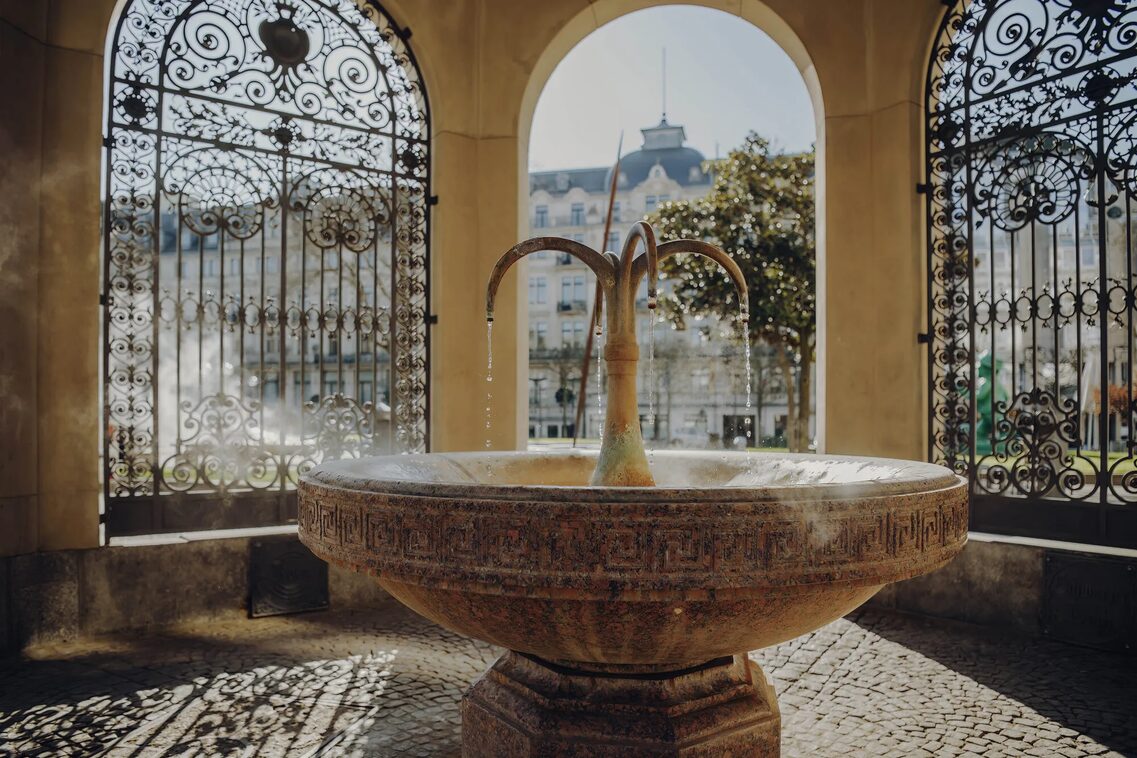
- In Wiesbaden, 26 hot springs gush from the ground. With temperatures reaching up to 67°C, they are among the hottest in Europe. The Kochbrunnen is the city’s hottest spring.
- Every day, about two million liters of thermal water rise to the surface from a depth of approximately 2,000 meters.
- On its journey from the depths, the water absorbs valuable minerals such as calcium, magnesium, strontium, and iron. While it was once used for drinking cures, today it is primarily used for thermal baths.
- The water is very salty—it contains up to six grams of table salt per liter. That amounts to about 14 metric tons of table salt (opens in a new tab) per day!
- Even the Romans made use of Wiesbaden’s thermal springs. Between 6 and 16 A.D., they founded the settlement “Aquae Mattiacorum” with thermal baths for the recovery of their soldiers. The inscription on the Kurhaus, “Aquis Mattiacis”—dedicated to the waters of the Mattiaci—commemorates this.
- The thermal water is an inexhaustible source of energy and is ideal for heating. Today, approximately 440,000 cubic meters of thermal water are extracted annually from five springs, generating 16 gigawatt-hours of heat (opens in a new tab). However, due to its high salt content, the thermal water is corrosive—when it comes into contact with oxygen, limescale forms quickly, which complicates its use.
Tip from "Whispers of the Springs": If you’d like to learn more about the hot springs and Wiesbaden’s beautiful natural surroundings, join the "Naturally Wiesbaden" (opens in a new tab) guided tour! You can also find even more facts and interesting information about the thermal springs in this brochure (opens in a new tab).
Fancy some relaxation? This way please!
Kaiser-Friedrich-Therme

The Kaiser Friedrich Thermal Baths are considered the jewel among Wiesbaden's thermal baths. None other than Emperor Wilhelm II, a regular visitor to the city's spas, once complained that Wiesbaden had "the most beautiful spa house in the world" but no public baths befitting its status. As a result, architect August O. Pauly created an Art Nouveau building that draws on the Roman bathing tradition.
The foyer, decorated with stucco and reliefs, gives you an idea of how stylish relaxation can look! The thermal baths are still fed by the Adlerquelle spring today.
Please note: clothing is not permitted ;-)
Bathhouse in the Hotel Schwarzer Bock

The Hotel Schwarzer Bock is considered Germany's oldest grand hotel. As early as the 15th century, crowned heads, artists, and spa guests from all over Europe sought relief and relaxation here. Today's bathhouse, which can be booked as a day spa, combines the listed spa architecture with a purist-designed spa featuring a thermal pool, sauna, steam bath, and relaxation areas. Incidentally, the thermal water comes from the neighboring Kochbrunnen spring. The highlight: the Kochbrunnen bath (opens in a new tab)!
Thermal bath Aukammtal

The Aukammtal Thermal Baths have just been renovated. Surrounded by lush greenery, they invite you to relax in the mineral-rich thermal water from their own spring. Both the indoor and outdoor areas feature various saunas (the highlight being the Quadrosauna) and steam rooms, as well as an outdoor pool with a water temperature of about 32° C.
The legendary origin of the springs
In ancient times, when giants and dragons still lived on Earth, the giant Ekko lived in the area that is now Wiesbaden. He felt disturbed by a dragon that lived in the dense forests of the Taunus. Ekko resolutely set out to kill the fire-breathing monster. But despite all his efforts, he was unable to find either the dragon itself or its hiding place.

This futile search made the giant furious. In his rage, he rammed his spear deep into the ground. Then he thought he heard the dragon's mocking laughter coming from the depths. To be sure, Ekko pulled the spear out again. At that moment, boiling hot water shot out of the earth and burned his bare feet. The pain only made him angrier.
Convinced that he had found the dragon's whereabouts, Ekko repeatedly thrust his spear into the ground—each time deeper than before. Suddenly, a powerful jet of hot water hit him directly in the face. He lost his balance and was barely able to catch himself. In doing so, his left hand and forearm sank deep into the softened ground.
Cursing, the giant finally gave up. With his face scalded and his feet swollen, he withdrew. But the marks left by his arm and fingers remained and, according to legend, are still visible today.
This, it is said, is how the valleys, hills, and thermal springs of Wiesbaden came into being. The surface of the hand forms the Wiesbaden basin, while the thumb, fingers, and forearm represent the valleys. And in the places where Ekko thrust his spear into the ground, hot water has been bubbling out of the ground ever since.
A tip from "Quellgeflüster": There’s a lovely children’s book about the giant Ekko: *Wiesbaden: A Journey of Discovery with the Giant Ekko (opens in a new tab)*. While rummaging through the attic, Marie and Bruno find a stack of old books about Wiesbaden in an old suitcase. As they read, they keep coming across the legend of the Giant Ekko. Here’s a video about how the book came to be!