
Typical Wiesbaden
Who was that, anyway...?
Many streets and squares are named after people who have close ties to Wiesbaden. Who are they?
- Adelheidstraße
Adelheid Marie of Anhalt-Dessau (opens in a new tab) (1833–1916) was the last Duchess of Nassau through her marriage to Adolph of Nassau and became Grand Duchess of Luxembourg in 1890 following her husband’s death. She lived for many years at Biebrich Palace and was known for her talent as a painter. She took lessons in Wiesbaden from the ducal conservator Otto Reinhard Jacobi. - Born and raised in
1817 at Biebrich Palace, Adolf von Nassau (opens in a new tab) (1817–1905) was deliberately groomed for his role as the future monarch. He reigned as Duke of Nassau from 1839 to 1866 and became Grand Duke of Luxembourg in 1890. In 1844, he married Grand Princess Elisaveta Mikhailovna Romanova (Elisabeth, Duchess of Nassau) in St. Petersburg. She died after nearly a year of marriage while giving birth to their daughter, who also did not survive. In her memory, the Duke had the Russian Orthodox Church (opens in a new tab) built between 1846 and 1855 to serve as her burial church. In 1851, Adolf married Princess Adelheid Marie of Anhalt-Dessau (see above) as his second wife. With Prussia’s annexation of the Duchy of Nassau in 1866, Adolf became the last ruling Duke of Nassau. - Christian-Zais-Straße
He had a decisive influence on classical Wiesbaden: Christian Zais (opens in a new tab) (1770–1820) designed the Kurhaus, which helped establish Wiesbaden’s reputation as a spa town, and the Erbprinzenpalais on Wilhelmstraße, which today houses the Wiesbaden Chamber of Industry and Commerce. - Dern’sche Gelände
The Dern’sche Gelände is named after Carl-Reinhard Dern (opens in a new tab) (1783–1863), a citizen of Wiesbaden and chief forestry councilor of the Duchy of Nassau. In 1809, the Nassau Court Chamber leased the pheasantry to him for management. In 1831, he inherited what is now known as the Dern Estate from a relative of his wife; the city of Wiesbaden purchased it from her in 1868. - Gustav-Freytag-Straße
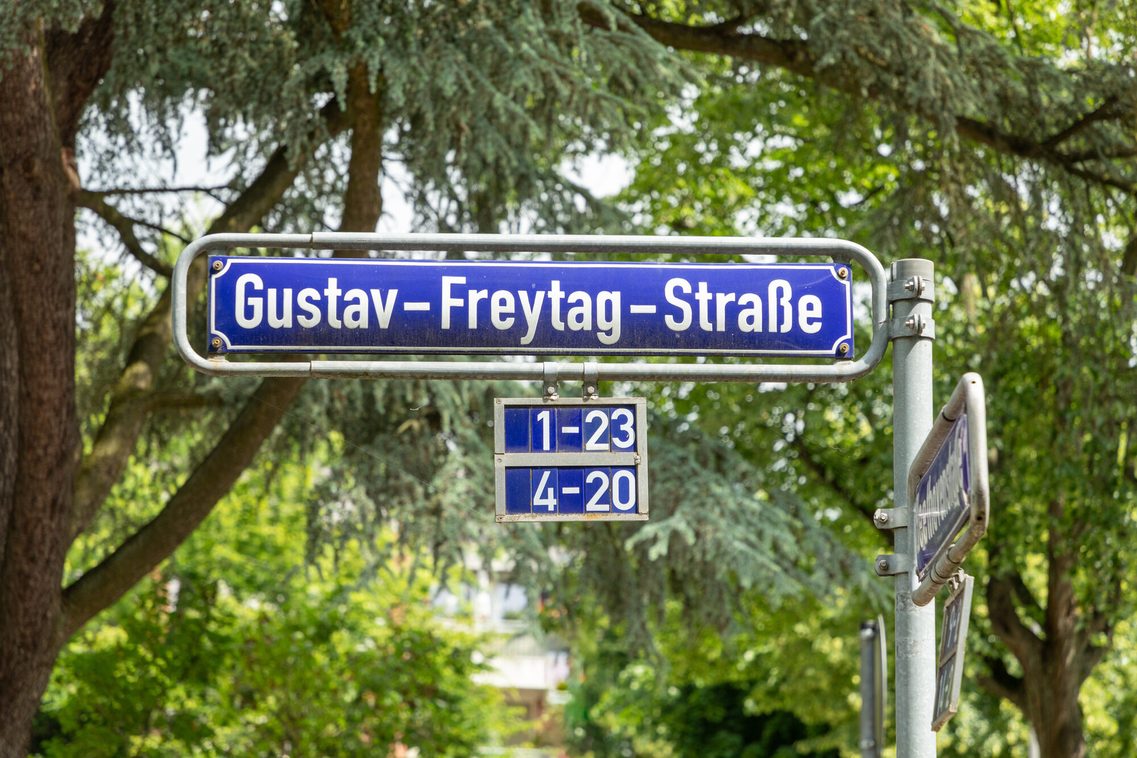
Gustav Freytag (opens in a new tab) (1816–1895) was one of the most famous German writers of the 19th century and the author of the novel *Soll und Haben*. Due to his bronchitis and Wiesbaden’s mild climate, Duke Adolf settled in a house on Biebricher Allee in 1877. In 1881, he moved into a villa on Hainer Weg—now Gustav-Freytag-Straße 18. He died there in 1895. - Ludwig-Beck-Straße
Ludwig Beck (opens in a new tab) was born in Biebrich and graduated from high school in Wiesbaden in 1898. He was part of the military resistance against Hitler and was a central figure in the attempted coup of July 20, 1944. - Luisenplatz
Luise of Saxe-Hildburghausen (opens in a new tab) (1794–1825) married Wilhelm of Nassau in 1813 and lived in Wiesbaden from 1816 onward after he assumed the throne as Duke of Nassau. She was active in social and educational causes and founded a school for girls in Wiesbaden. This made her one of the early 19th-century princesses who championed better education for women. After the birth of her youngest daughter, Marie—one of eight children—she died at Biebrich Palace. - Wilhelmstraße
As the first ruling Duke of Nassau, Wilhelm (opens in a new tab) (1792–1839) promoted the development of Wiesbaden into a royal residence and spa town. Wilhelm made Biebrich Palace his residence, which he had redesigned according to his own vision, along with the accompanying palace park. On his initiative, the Platte Hunting Lodge was also built and completed in 1824.
Did you know?
- The Russian painter Alexei von Jawlensky lived in Wiesbaden from 1921 until his death in 1941 and created numerous famous works here that are among the most significant of Expressionism. His grave is located at the Russian Orthodox Cemetery on the Neroberg—and the Museum Wiesbaden (opens in a new tab) houses the world’s most significant collection of his works, with 111 pieces! You can follow in his footsteps along the Jawlensky Trail (opens in a new tab).
- During his military service in Germany, Elvis Presley (opens in a new tab) regularly stayed in Wiesbaden. He entered Germany via Erbenheim Airport in 1958 before being stationed in Friedberg. It was in Wiesbaden that he met his future wife, Priscilla Beaulieu Wagner.
- The son of automotive visionary Adam Opel—Wilhelm von Opel (opens in a new tab)—lived in Wiesbaden, was made an honorary citizen of the city in 1941, and died in Wiesbaden on May 2, 1948.
- During Wiesbaden’s heyday as an international spa resort, numerous prominent figures (opens in a new tab) visited the city, including Johann Wolfgang von Goethe, Tsar Nicholas II, and Empress Elisabeth (“Sisi”) of Austria.