Neighborhood-related population and social data and analyses
The social atlas provides a wide range of up-to-date social and population structure data relating to specific districts. The social area analysis is published approximately every 5 years and analyzes the structure and social needs of the districts.
Social Atlas
The Social Atlas provides the most up-to-date figures for each neighborhood and the city as a whole on population and household structures, mobility, housing, labor force and educational participation, the extent of social assistance, and political participation.
The Social Atlas thus provides—on the one hand—the data foundation for planning and shaping municipal social policy as well as youth welfare and social planning for the city districts. On the other hand, it offers social workers information about “their” district, their respective target groups, as well as about living conditions, challenges, needs, and resources within the district and among the people living there.
Social space analysis
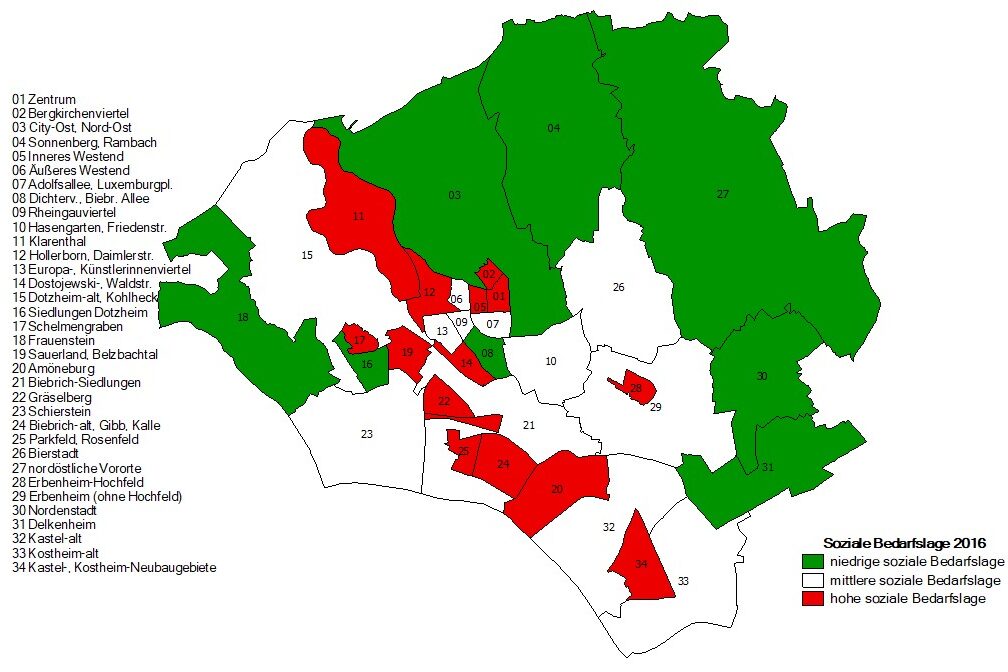
The socio-spatial analysis describes and analyzes the socio-spatial patterns of social inequality in Wiesbaden’s 34 socio-spatial districts.
Using a variety of indicators, the social needs and risks associated with living conditions in the neighborhoods are measured and described, thereby illustrating the current status of needs in the neighborhoods. Furthermore, based on these indicators, the developments in the neighborhoods are documented and described over time.
The varying levels of social need across the districts are the central finding of the social space analysis and form the basis for the planning, placement, and further development of social services and initiatives by the Office of Social Work in each district.