Aukammtal Landscape Park
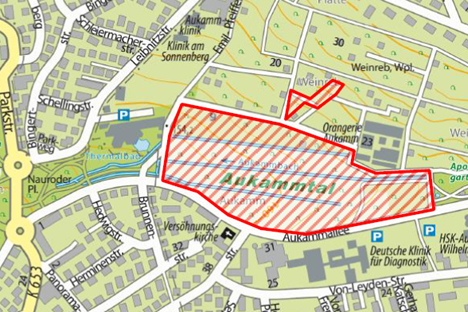
The Aukammtal Landscape Park is a near-natural inner-city recreational area. It is located to the east of the thermal baths in Wiesbaden and is around eleven hectares in size. Wide meadows, small groups of trees and large reed beds invite you to go for a walk, relax and experience nature.
To the south, the park is bordered by Aukammallee; to the north, by Weinreb Path. To the west lies the thermal baths, and to the east, the Orangery and the Apothecary Garden. The Bee Education Park in the Apothecary Garden is also part of the landscape park.

Significance in the urban green system
The Aukammtal Landscape Park is part of a large green corridor that runs through Wiesbaden. Stretching from the Kurhaus through the Kurpark and the spa facilities, this green corridor extends to the eastern part of the city and ends at the Aukammtal Landscape Park.
In this way, the Aukammtal Landscape Park helps ensure that the city’s green spaces are well connected. At the same time, it plays an important role in the urban climate. Wetland habitats provide cooling, promote fresh air circulation, and offer space for nature-based recreation.
The Aukammbach stream defines the landscape park. With three tributaries, it flows through the landscape park and continues through the Aukammtal grounds before emptying into the Salzbach stream in the spa grounds.

Experience nature
Unpaved paths and small bridges wind through the park, passing reed beds, old and young willow trees, and hay meadows of various types. At the eastern end, a large meadow with a pavilion connects the landscape park to the apothecary garden.
Those who prefer paved paths can walk around the park via Emil-Pfeiffer-Weg or Weinreb. On the way to the Orangery and the Apothecary Garden, you’ll also pass small orchards and garden areas.
Special features
Until the 1960s, the land within the landscape park was largely used for gardens and agriculture. There were hardly any trees at that time. Gradually, the use of the particularly damp to wet areas was abandoned. Shrubs and large reed beds began to grow. Since the 1990s, individual areas have been specifically restored to their natural state. Through regular maintenance, this has developed into today’s near-natural landscape park.
Today, the area is regularly maintained on behalf of the Environmental Agency. Through targeted mowing of the meadows and the care of trees and shrubs, the park’s near-natural character is preserved. At the same time, this protects and enhances the habitat for plants and animals.
Characteristic of the landscape park are the floodplain-like trees and shrubs along the Aukammbach stream and its tributaries. They keep the central area of the park pleasantly cool and shady even on warm days.

This picture is complemented by numerous meadows on moderately moist to wet areas, as well as extensive reed beds.
Although the landscape park is located in the heart of the city, it offers a surprising variety of habitats. These include protected biotopes. The park is therefore an important refuge for many native animals and plants. In addition to recreation, learning also plays an important role: the park is also used for environmental education and nature tours.