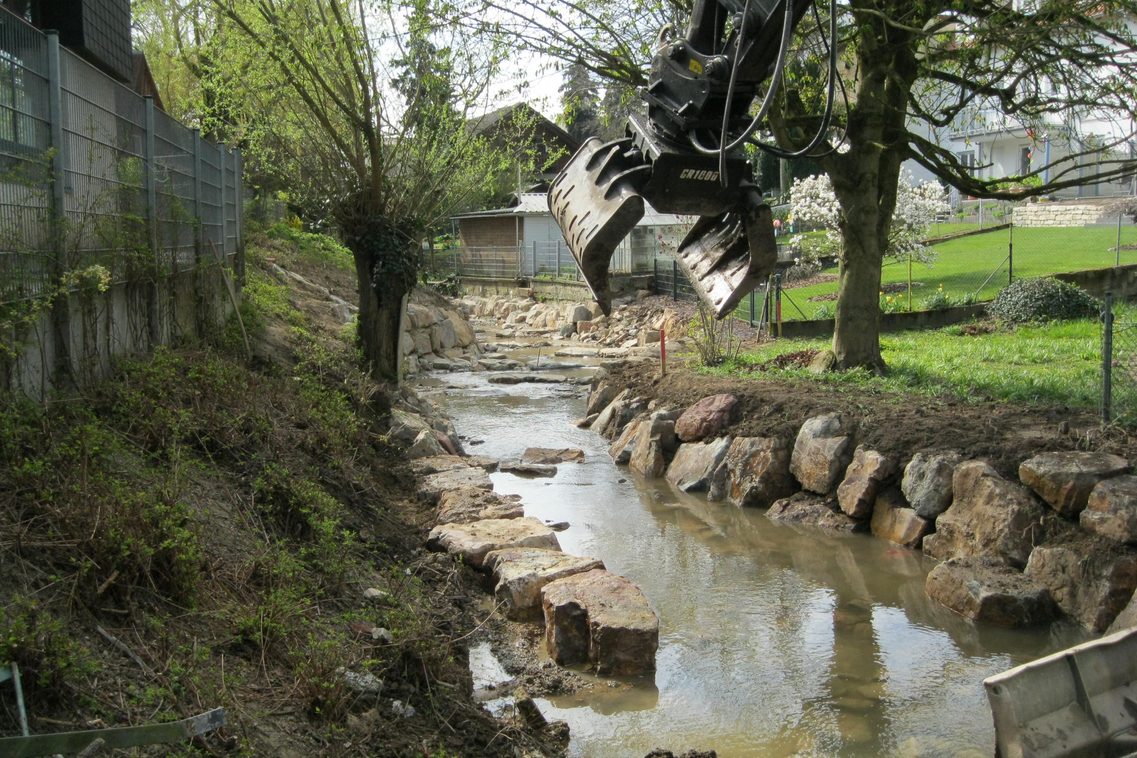
Renaturation of the Klingenbach stream in Breckenheim town center
In Breckenheim, the Klingenbach was heavily obstructed and therefore in a poor ecological condition. To improve this, a 55-metre section of the stream was renaturalized by the environmental agency in 2020.
In the Breckenheim area, the Klingenbach was characterized by extensive reinforcement of the riverbed and banks. This was likely constructed to quickly drain floodwaters through the town and minimize maintenance costs (such as cutting back vegetation). Following the 2013 comprehensive assessment conducted by the State of Hesse to implement the EU Water Framework Directive, this section was classified as “completely altered.” This corresponds to the worst possible condition.
The Klingenbach was therefore renaturalized in 2020 by the Environmental Agency along a 55-meter stretch from the “Alte Dorfstraße/Klingenbachstraße” intersection to “Neue Schulstraße” within the municipal waterway area. Survey work conducted as early as 2010 revealed that the Klingenbach has a width ranging from 3.70 to 4.60 meters. Old grass pavers were removed, and a new, near-natural stream section was created in the upper reaches, featuring still-water zones, gravel banks, and natural structural elements. To compensate for the necessary tree removals during the construction project, floodplain-typical trees, shrubs, and grasses were planted. Additional nesting aids for bird and bat species have been installed.
Restoration of the Klingenbach Stream in Breckenheim.
The planned project presented all parties involved with a difficult starting point. In the town center, the Klingenbach flows through a densely built-up area, past a daycare center, infrastructure facilities, and various bridge structures. Complicating the implementation was the fact that the Klingenbach, in the upper reaches of the Wickerbach system, is classified as a third-order watercourse and is home to a population of stone crayfish. Under species protection law, this species is considered to be of particular conservation value and is also listed as a critically endangered species on Germany’s “Red List.”
Consultations on the Renaturation
Through numerous informational meetings with the Breckenheim Local Advisory Council, residents directly adjacent to the stream, various government agencies, and the permitting authority—the Darmstadt Regional Council—consent and consensus regarding the implementation of the restoration project were ultimately achieved.
Evidence Preservation Procedure
Prior to the start of construction work, a preservation of evidence procedure was conducted by an independent expert, who documented existing damage to buildings, structures, and safety equipment.
Electrofishing
Electrofishing involves the use of electric current to catch fish. Before construction began, fish were caught for their protection and released downstream in a safe location. Electrofishing does not harm the animals.
Disinfection
The stone crayfish found in the Wickerbach system is threatened by crayfish plague and by invasive non-native crayfish species such as the signal crayfish. Therefore, disease prevention was a high priority as part of the renaturation efforts aimed at protecting the stone crayfish.
The construction and planning costs amount to around 1.1 million euros. As the renaturation section is defined in the Water Framework Directive's program of measures, the project is being subsidized with around 920,000 euros from the Hessian state program "Water and Flood Protection".
The Klingenbach is now once again accessible to the public in many places. The recreational value has been significantly enhanced by the renaturation work carried out within the town.
By creating a near-natural stream bed, the Klingenbach is once again passable for fish and other aquatic organisms. Ultimately, renaturation in urban areas leads to a significant ecological enhancement of the “water bodies” habitat, particularly for native flora and fauna.
Due to the difficult access and confined working conditions, all material deliveries and removals had to be carried out within the stream bed. Steel plates served as a temporary structure, forming a access road across the Klingenbach.
The Klingenbach now exhibits significantly increased flow diversity along the stream bed. This means that the current can vary in speed—from fast to slow—and is highly varied. It is once again recognizable to observers as a flowing watercourse. Due to the dense development, the riparian zone cannot develop naturally even after renaturation.
A renovation of the public stream bridge could not be carried out for cost reasons.
Therefore, the reinforced concrete bridge deck was temporarily supported on its sides, then reinstalled upon completion of the construction work and given a fresh coat of paint.
Before
The Klingenbach was narrow, the riverbed was barely visible and a narrow section made it difficult to develop the watercourse.
An existing bridge blocked the area and had to be removed for the construction work.
Some of the vegetation on the banks had to be removed from private properties.
During the construction period
Tight space conditions made a temporary construction road made of steel plates necessary.
Construction machinery could only reach the site via the closed footpath next to the daycare center.
Many residents, especially children, followed the work with interest.
Afterwards
The riverbed was significantly widened and now has a greater impact on the townscape.
Stepping stones have replaced the old bridge; a new bridge was built where necessary.
The stream can be experienced again - also for children thanks to the widened areas at the daycare center.
New benches increase the quality of stay.
A new section of water was created by purchasing land; the old course now serves as a still water zone.
The planting of the renaturation section took place in November 2020. As the renaturation measure on the Klingenbach required the removal of bank planting on private properties, replanting with native shrubs was carried out in consultation with the local residents.
The selection of shrubs and bushes was based on the species protection report for the approval planning. Among others, willow, hawthorn, coneflower and honeysuckle were planted. Among the perennials and grasses, swamp sedge, false cyperus and meadowsweet were planted as a priority.
The floods in February 2021 caused many rivers and streams to burst their banks. The much-needed rain, which was lacking in 2019 and 2020, and the current snowmelt caused water levels to rise sharply. The floods also put the new renaturation measure on the Klingenbach to the test.
A conclusion
The safety elements, such as boulders, boulder walls or stone embankments, have not only held up. In fact, new natural structural elements such as gravel banks and deposits have formed in the area between the nursery and Klingenbachstrasse. The mallards at least liked this ...