They were pure luxury and had many prominent guests - the Wiesbaden grand hotels of the 19th century! Tour guide Dagmar Binder offers a guided tour on this topic. A conversation about Wiesbaden's time as a cosmopolitan spa town, famous guests and popular pastimes.
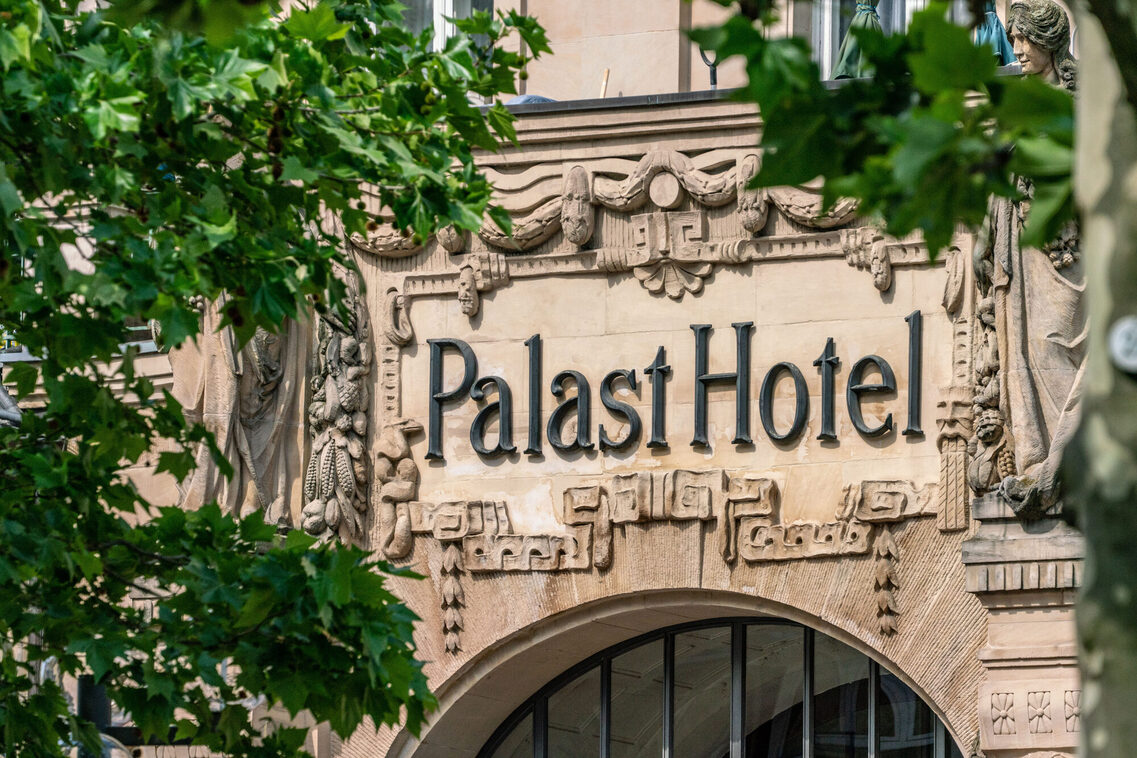
The Palace Hotel was a luxurious grand hotel with illustrious guests
Miss Quellgeflüster: Who met in Wiesbaden in the 19th century? Dagmar: Over the course of the 19th century, the health motivation for taking a cure often changed to a cultural experience. You needed time—so you didn't have to work—and you needed money—for a carriage, the hotel. So elite groups met in fashionable health resorts.
When the emperors come, the nobles and rich people from all over Europe naturally come too.
Miss Quellgeflüster: What was so special about Wiesbaden? Dagmar: Until 1866, Wiesbaden was the capital of the Duchy of Nassau—and then it fell to Prussia. Well, when the emperors come, the nobles and rich from all over Europe naturally come too. First came Wilhelm I, and then his grandson. Emperor Wilhelm II spent 20 years in the city, usually several weeks in May. He loved Wiesbaden, and Wiesbaden loved him.
Miss Quellgeflüster: How did Wiesbaden develop into a world-class spa town? Dagmar: Around 1800, the city had less than 3,000 inhabitants, but by 1905, the population had grown to 100,000. Wiesbaden now had 200,000 spa guests annually. Unimaginable! This allowed it to call itself a "world spa town." And for the "select guests," there were more than 50 grand hotels here! This was unique in Germany when you consider the number in relation to the population.
Fräulein Quellgeflüster: What role did the spa industry play? Dagmar: There was no industry in Wiesbaden and hardly any commerce. Actually, there was only the hotel and restaurant business. And after the big slump in guest numbers due to World War I, Wiesbaden had a problem. But that's another story...
Dagmar offers various guided tours - also to the Wiesbaden Grand Hotels
Miss Quellgeflüster: The spa house was the social center... Dagmar: Our beautiful spa house—described by Emperor Wilhelm II as "the most beautiful spa house in the world"—has no bathing facilities. It served solely as a social center for "amusement," with halls for balls, concerts, and socializing. There were reading rooms where all 76 daily newspapers were available every day and a writing room in a Renaissance setting – the Ferdinand Hey'l Salon. Writing postcards was a cult among spa guests, who sent stacks of them every day. The Reichspost transported up to one and a half million postcards a day!
Writing postcards was a cult among spa guests!
Miss Quellgeflüster: What were the best addresses in the city? Dagmar: I find the history of the Palast Hotel on Kranzplatz particularly interesting—even though it hasn't been a grand hotel for a long time. Its uniqueness begins with its Art Nouveau architecture. No one in the spa district had dared to do this before, as Emperor Wilhelm II detested Art Nouveau. That's why we often see the so-called "Wiesbaden Art Nouveau" style in hotels here – Wilhelminian in the lower part and Art Nouveau elements only at the top. Anyone who would like to know more – there is so much to tell – is welcome to joinone of my tours (opens in a new tab).
Fräulein Quellgeflüster: Which guest caused a particular sensation? Dagmar: Oh, there were so many! I'll just refer back to the Palast Hotel again. Our state theater had booked Enrico Caruso for October 1, 1908, to perform as the Duke of Mantua in Verdi's opera "Rigoletto" for 10,000 gold marks, which is about 100,000 euros today! The day before, he had already booked the largest suite at one of my tours (opens in a new tab).
Fräulein Quellgeflüster: Which guest caused a particular sensation? Dagmar: Oh, there were so many! I'll just refer back to the Palast Hotel again. Our state theater had booked Enrico Caruso for October 1, 1908, to perform as the Duke of Mantua in Verdi's opera "Rigoletto" for 10,000 gold marks, which is about 100,000 euros today! The day before, he had already booked the largest suite at the Palast Hotel. And to warm up his voice, he stepped out onto the balcony. People flocked to Kranzplatz to listen – and the ladies fainted in droves...
"Whispers from the Source" Tip: Dagmar Binder offers a variety of exciting guided tours ("In the Emperor's Footsteps," "In Goethe's Footsteps"). Find all the details here (opens in a new tab)!
Palace Hotel
The Palace Hotel was a luxurious grand hotel with illustrious guests
The former hotel, with its elegant Art Nouveau façade, was built between 1903 and 1905 on the remains of a Roman thermal bath complex – a discovery that came to light during the demolition of two older bathhouses to make way for the new palace hotel. With 150 rooms, a charming courtyard, and first-class amenities for the time, it was on a par with renowned establishments such as the "Hotel Rose" and the "Schwarzer Bock."
But the glory was short-lived: with the outbreak of World War II, spa guests stayed away and the hotel was used as a military hospital. After the war, the American armed forces took over the building. In 1977/78, it was finally converted into a modern residential complex. From the outside, the building is almost unchanged, but inside, only a few details such as the magnificent staircase and the winter garden with Art Nouveau glazing bear witness to its former glory (viewing permitted).
Prominent guests: Enrico Caruso – world-famous Italian tenor, who is said to have spontaneously performed a song at the window of his suite.
The hotel's name comes from its tenant, Margarethe zur Rose. In its heyday, the hotel had around 200 salons and bedrooms as well as 55 bathrooms. The spacious bathing facilities were fed directly from the Kochbrunnen spring, and the courtyard featured a large tennis hall – the latest craze at the time. By 1828, the Hotel Rose was already one of the four largest and most elegant bathhouses and guesthouses in Wiesbaden. Today, the historic rooms house the Hessian State Chancellery.
The Hotel Viktoria could have looked like this or something similar
In 1845, the luxury hotel on Wilhelmstraße opened its doors – on the very spot where the Reinhard Ernst Museum is located today. It offered 70 elegant rooms and salons as well as numerous bathrooms fed by its own thermal spring. A special highlight was the roller skating rink built in 1877 – the second of its kind in the German Empire. In 1887, the hotel was expanded: over 120 luxurious rooms, magnificent function rooms, and a dining room for 500 guests made the Hotel Viktoria one of Wiesbaden's leading establishments. During the devastating bombing raid on February 2–3, 1945, the hotel was completely destroyed and never rebuilt.
Prominent guests: Fyodor M. Dostoevsky – who ruined himself playing roulette at the Wiesbaden casino in 1866. As a result, he had to deliver a novel to his publisher at short notice. The result was "The Gambler," in which he dealt with his gambling addiction in literary form.
Hotel Schwarzer Bock - Germany's oldest grand hotel
The Ingelheim room in the Hotel Schwarzer Bock
This historic hotel—now the Radisson Blu Schwarzer Bock—is considered Germany’s oldest grand hotel. Like many other spa hotels, it was built directly next to a thermal spring for practical reasons. Local legend has it that the first owner was Mayor Philipp zum Bock—and because he had black hair, his establishment was named “Zum Schwarzen Bock.”
The second most famous room in the hotel is the “Ingelheimer Zimmer” with its precious wood paneling, which originates from Ingelheim Castle and found its way into the hotel in an unusual manner—as a result of a lost bet.
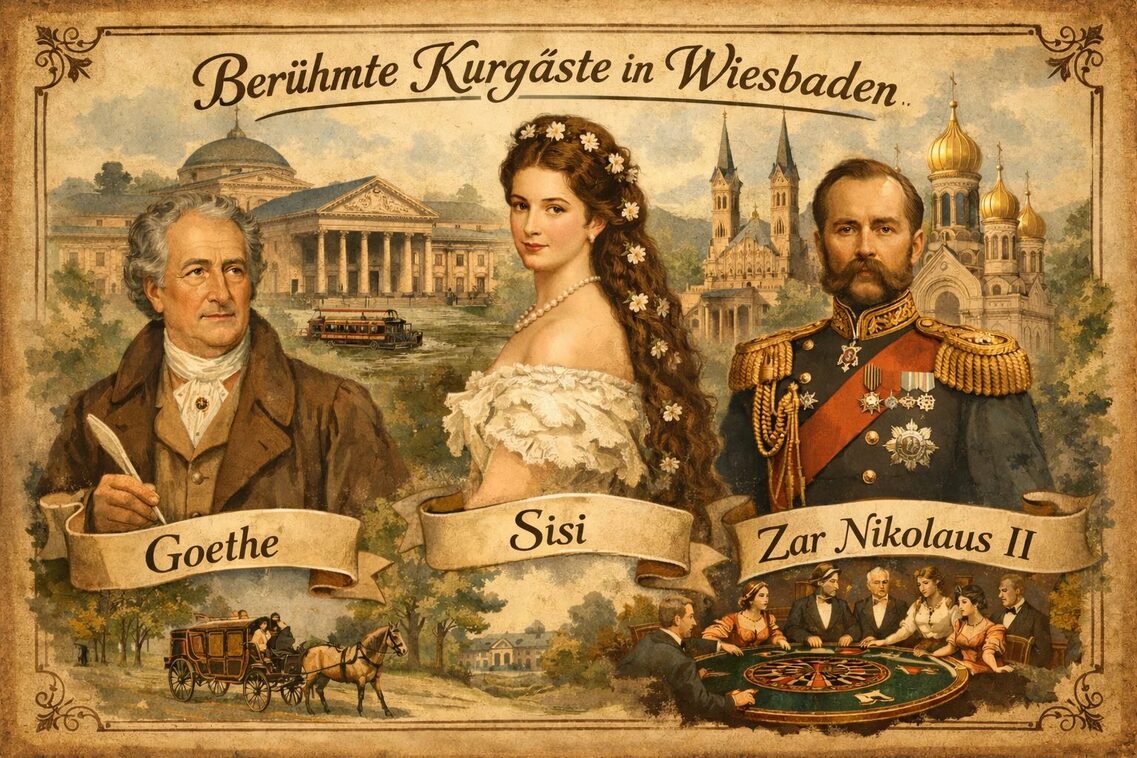
Johann Wolfgang von Goethe traveled to Wiesbaden several times for spa treatments. He also stopped here on his Rhine trip with his friend Herder and wrote about the spa gardens and hot springs in his diary.
Emperor Wilhelm II was a frequent guest in Wiesbaden and had a major influence on its development into a world-class spa town. Among other things, he supported the construction of the Kurhaus and the Hessian State Theater.
In 1884, Elisabeth of Austria, Sisi, occupied 60 rooms (!) at the Hotel Vier Jahreszeiten and received a bouquet of violets from hotelier Wilhelm Zais, as reported by the Neuigkeits-Welt-Blatt in Vienna.
Tsar Nicholas II and his wife Alexandra Feodorovna took the waters in Wiesbaden several times and attended services at the Russian Orthodox Church on Neroberg during their stays. Many other Russian aristocrats followed their example – the winter months were particularly popular. The world-famous Italian tenor Enrico Caruso was a guest at the Palast-Hotel in 1908 and spontaneously gave a singing performance at the window.
Franz Liszt and Richard Wagner were closely associated with Wiesbaden's musical life; Liszt gave several concerts there.
The Prussian politician and later Reich Chancellor Otto von Bismarck repeatedly recovered from the stresses of politics in Wiesbaden, especially during the Franco-Prussian War.
In the 19th century, spa stays were long and ritualized. Four to six weeks was considered a relatively short stay for minor ailments. The "classic" spa stay lasted six to twelve weeks. Very wealthy guests, aristocrats, or chronically ill patients often stayed for several months. Many guests returned every year, often at the same time, and stayed for months in the same hotel or a rented apartment.
The day began early with drinkingcures at the thermal springs, followed by baths and medically prescribed treatments. After lunch, the program included rest, walks, and social gatherings. In the evenings, guests attended concerts, the theater, or social events.
Because of the long stays, it was important that the spa guests felt well entertained. There were daily concerts in the spa house or in the spa gardens, carriage rides through the park, boat trips on the pond, picnics, lectures, and readings. Balls, soirées, and receptions provided opportunities for dancing and "seeing and being seen." Roulette and card games were considered sophisticated evening entertainment.
A spa stay in Wiesbaden was a truly holistic experience!