History of the Wiesbaden City Archive
The Wiesbaden city archives date back to the 16th century. At the end of the 19th century, Wiesbaden's first full-time city archivist, Christian Spielmann (1861-1917), organized the city archive according to scientific criteria for the first time. Since then, the city archive can look back on around 130 years of history.
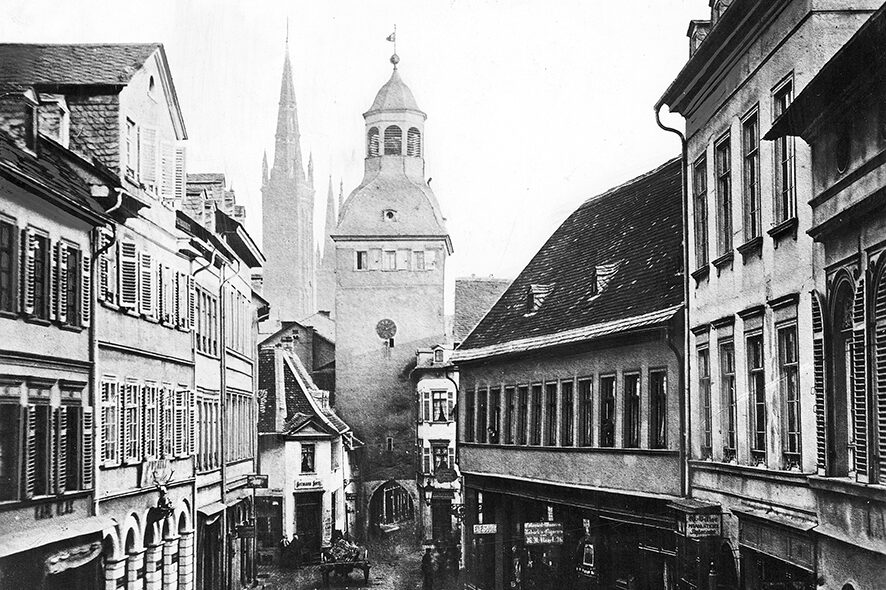
From the beginnings to the end of the Spielmann era (1815-1920)
The first known repository for the city of Wiesbaden’s records was the clock tower on Marktstraße in the early 16th century. However, the devastating city fire of 1547 destroyed a large portion of the municipal archives dating from the Middle Ages. This was compounded by the destruction of records in the early 18th century due to lack of space. The remaining archive stayed in the clock tower and was provisionally organized and cataloged in 1850–51 by Karl Rossel (1815–1872).
As Wiesbaden grew rapidly throughout the 19th century as a thriving spa and residential city, urban renewal led to the demolition of the clock tower in 1873. The archive was initially housed in the attic rooms of the Old City Hall (today the Wiesbaden Registry Office), then, starting in 1880, in one of the tower rooms of the Marktkirche, and finally, beginning in 1892, in the northeast tower of the New City Hall.
After the move to the New City Hall, the existing records were organized by Wiesbaden’s first city archivist, Christian Spielmann (1861–1917), and supplemented with new collections. With Spielmann’s appointment in 1892, the Wiesbaden City Archives thus emerged as a modern municipal institution.
Dissolution, refoundation and professionalization (1920-1989)
After Spielmann’s death in 1920, Lothar Lüstner (1882–1955) took over as director of the city archives for four years. Due to a lack of space, the growing volume of records—resulting from modern office organization—could no longer be fully accommodated in City Hall. This was compounded by budget constraints faced by the city in the wake of World War I and the decline of the spa industry. In 1924, the decision was therefore made to integrate the City Archives and its historical collections into the Nassau State Library, which had been housed in a new, functional building on Rheinstraße since 1913. In 1933, the archive’s holdings were transferred to the State Archives on Mainzer Straße.
During World War II, even the oldest parts of the city’s archival records were moved, along with state archival materials, to Ehrenbreitstein Fortress in Koblenz. The remaining municipal archival records were moved in April 1944 to a basement room at the boys’ school on Hebbelstraße for protection against air raids.
The municipal registry, which mainly contained documents from the 1920s and 1930s, remained in City Hall. As a result of the air raid on February 2, 1945, and the deliberate destruction of records during the final weeks of the war, the collection of documents from the Weimar Republic and the “Third Reich” was severely depleted.
After World War II, rooms at Schützenhofstraße 4 initially served as temporary quarters for the city archives. In 1948, Wilhelm Schauß (1896–1953) once again took over as city archivist. In 1951, the archives moved into the rebuilt New City Hall; former air-raid shelters in the basement served as the main storage facility, and Dr. Herbert Müller-Werth (1900–1983) became director of the city archives until his retirement in 1965.
From 1974 onward, Günter Mischewski (1942–2006) headed the archive for 25 years. Mischewski was also the first specialist archivist trained at the Federal Archives to serve the City of Wiesbaden. From 1978 until the end of 1989, the City Archives were housed in the villa at Humboldtstraße 6, designed by Alfred Schellenberg (1850–1932). However, the historically protected building offered only insufficient storage space for the archival materials. In 1987, working conditions at the City Archives were significantly improved through the creation of two additional archivist positions. In 1991, the City Archives began publishing its own series of publications.
The city archive in the former Rotaprint factory (1990-2020)
In 1990, the Wiesbaden City Archives moved for the last time. Following an investment of 2.5 million DM, the archives moved into the former Rotaprint printing machinery production facility at the new address “Im Rad 42,” which had been renovated to meet the archives’ needs. Since then, the City Archives has had functional office and storage spaces, as well as spacious workstations for users. Good public transportation access (ESWE stops “Kleinfeldchen-Stadtarchiv” and “Künstlerviertel-Stadtarchiv”) as well as free parking make it easy to visit.
Since the early 1990s, the City Archives has also been responsible for the memorial sites and places of remembrance related to the history of National Socialism in Wiesbaden. This responsibility, along with historical education efforts, is now consolidated within the Memorial Sites Division.
From 1999 to 2019, Dr. Brigitte Streich served as director of the City Archives and, together with her team, established the City Archives as a place of encounter and culture through numerous historical exhibitions, collaborations with Kunstarche e.V.—which is also housed in the City Archives building— and a diverse program of events, established the City Archives as a cultural hub and meeting place. Since 2005, the nonprofit Verein zur Förderung des Stadtarchivs Wiesbaden e.V. (Association for the Promotion of the Wiesbaden City Archives) has supported the Archives’ work.
The cataloging of the collections has been accelerated since 2003, particularly in the areas of photographs, films, and audio recordings, through the establishment of a dedicated “Multimedia Archive” department. At the same time, efforts to catalog and preserve the archival records have continued to advance. The publications in the City Archives’ series and the *Wiesbaden City Encyclopedia*, published in 2017, have made a lasting contribution to the historiography of the state capital.

Today: Our story. In good hands.
Today, the City Archives’ ten permanent employees, along with its project and support staff, handle approximately 3,000 user requests per year and assist about 350 users in the reading room, for whom more than 1,000 items are retrieved and returned to storage from the archives’ collection, which spans approximately 6.2 linear kilometers. In 2020, about two-thirds of the documents held by the City Archives were cataloged and thus accessible to visitors.
In addition to archival records, the City Archives possess a large collection of special formats. As of 2021, these include a map collection with approximately 21,500 maps and plans, approximately 18,500 posters, around 6,000 postcards and fold-out brochures, 1,700 engravings, 798 videos and audio tapes, 406 other data carriers such as CD-ROMs, and approximately 104,000 photographs in the form of prints, slides, negatives, and glass plates.
Since 2020, the archival holdings have also been searchable online, and requests for materials in the reading room can be submitted online. In 2021, the legal framework for archival work dating from the early 1990s—the Archival Charter of the State Capital of Wiesbaden and the Rules of Use—was fundamentally revised by the City Council.
In 2025/2026, the City Archives underwent its most extensive expansion to date. With 2,400 square meters of additional space in the basement of the existing building and a storage area expanded by 7.5 linear kilometers, the City Archives doubled its capacity and now has sufficient space to last until the middle of the century. In addition, new functional spaces—including a digitization workshop, a delivery and quarantine zone, and additional office workstations—were put into operation. The renovation project took a total of 14 months, during which regular archive and reading room operations were maintained throughout, with the exception of a few weeks.
Contact us
City archive
Address
65197 Wiesbaden
Postal address
65029 Wiesbaden
Arrival
Notes on public transport
Public transportation: Bus stop Kleinfeldchen/Stadtarchiv, bus lines 4, 17, 23, 24 and 27 and bus stop Künstlerviertel/Stadtarchiv, bus line 18.
Telephone
- +49 611 313022
- +49 611 313977
Opening hours
Opening hours of the reading room:
- Monday: 9 a.m. to 12 p.m.
- Tuesday: 9 am to 4 pm
- Wednesday: 9 am to 6 pm
- Thursday: 12 to 16 o'clock
- Friday: closed