
Why you have to go to the Caligari Filmbühne
According to director Volker Schlöndorff, the newly renovated Caligari FilmBühne on Marktplatz is “a gem among German movie theaters.” Claudia Steiger reveals what makes it so special and why the movie-going experience there is simply one-of-a-kind!
Miss Quellgeflüster: The Caligari has a very special interior design...
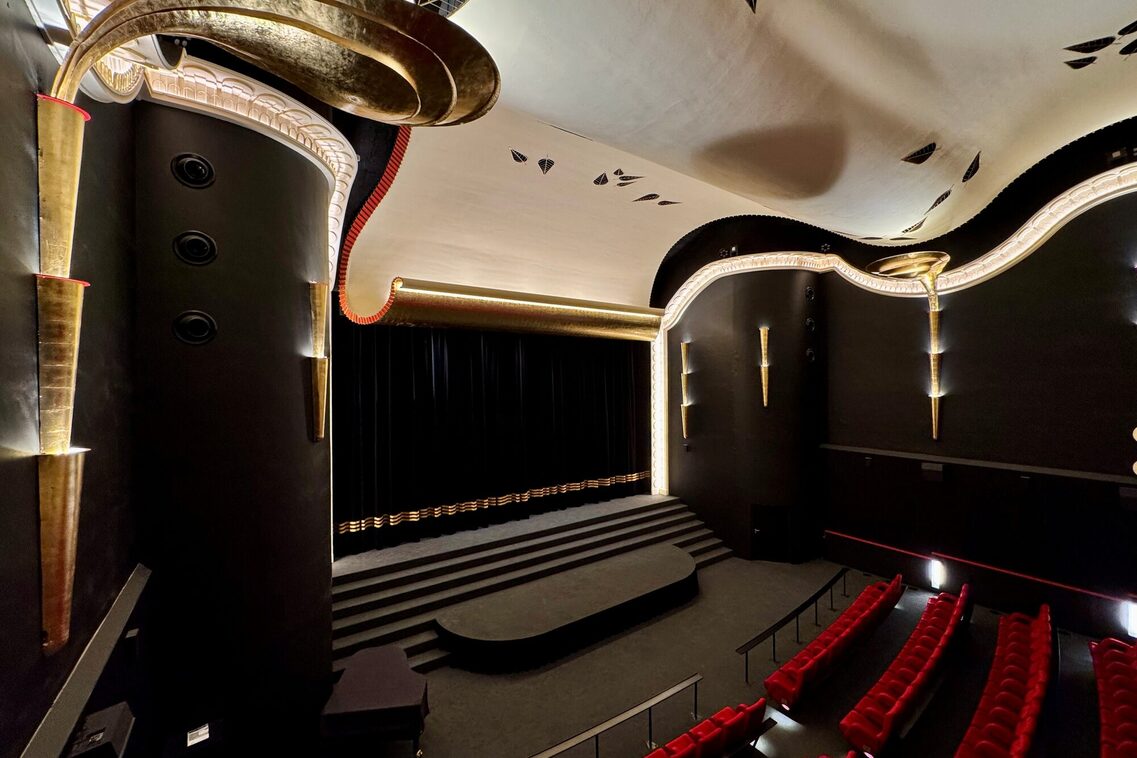
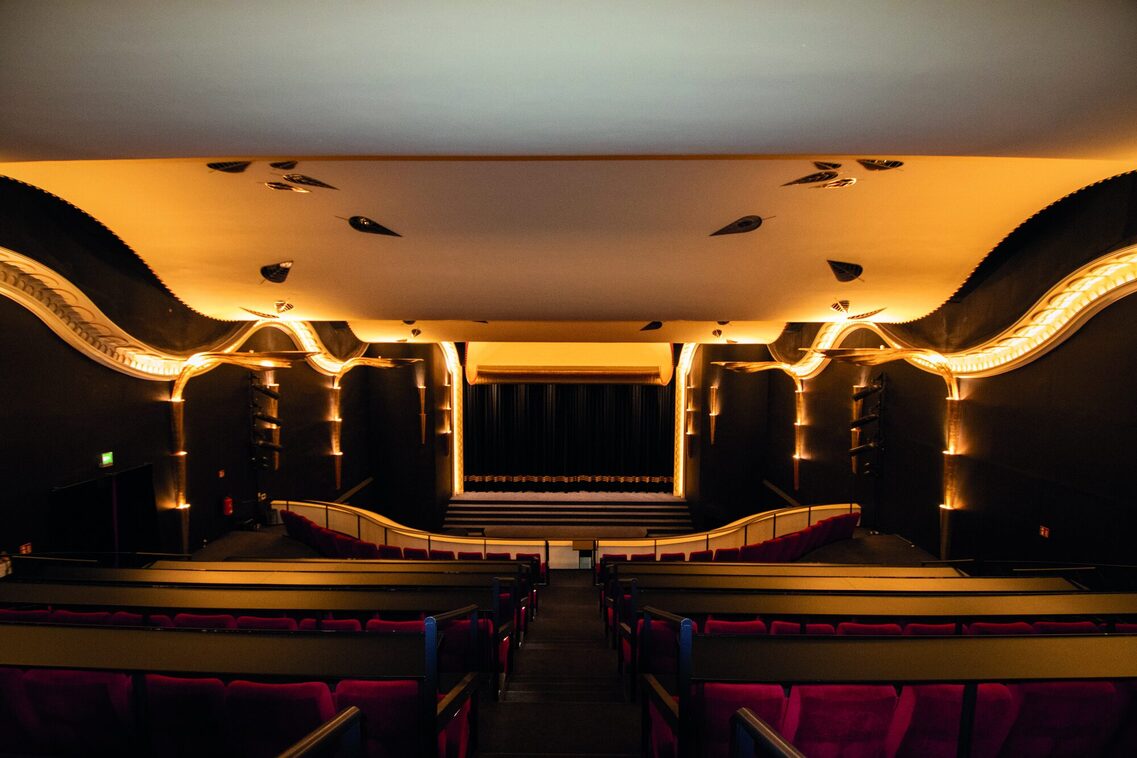
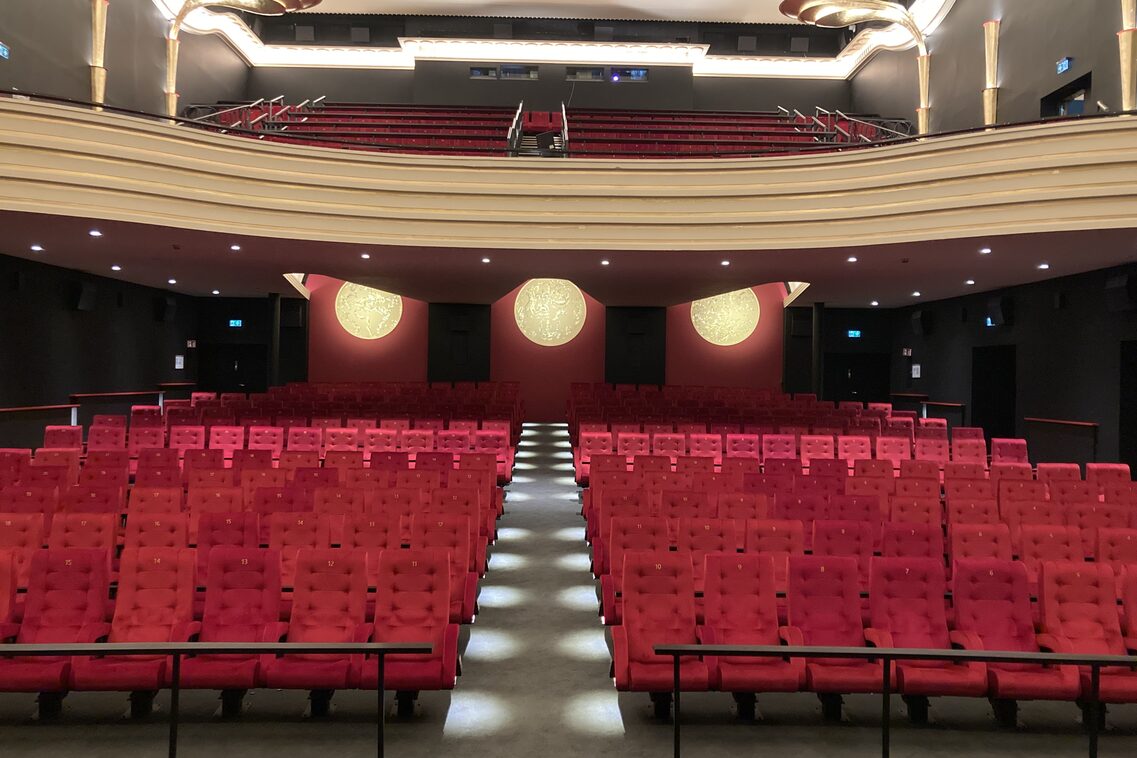
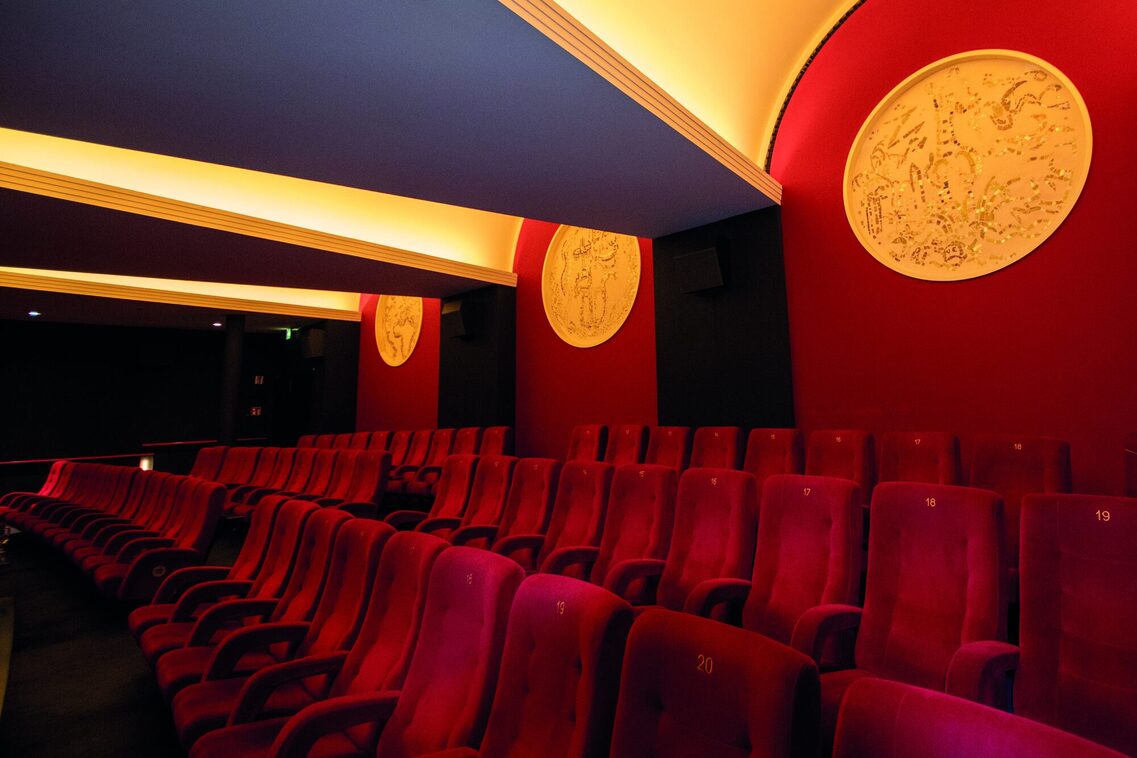
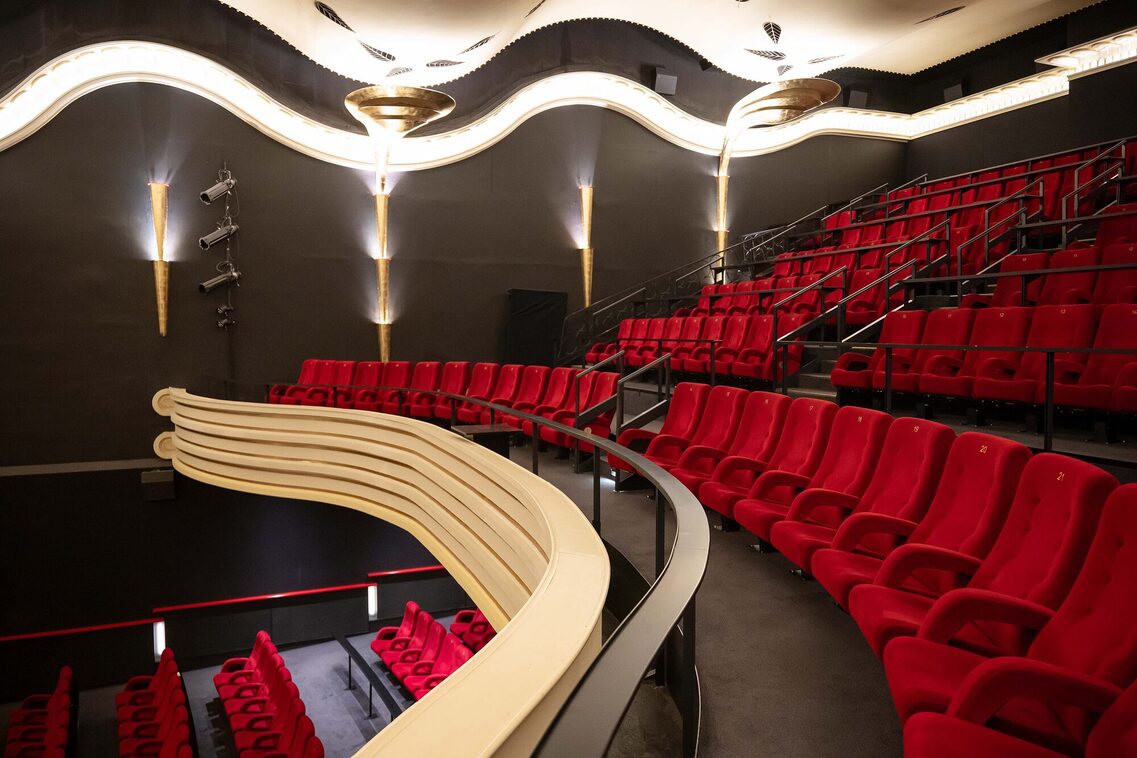
Claudia: You could say it’s one of a kind! The interior design and architecture were realized in 1955 based on plans by architect Ludwig Goerz. It has been largely preserved to this day and is a protected historic landmark. Since the major renovation in 1999–2000, the auditorium has been decorated in black with gold accents and a curved, undulating ceiling. Above the screen is a sort of golden curl that resembles an unrolled film reel. Another distinctive feature is the three circular mosaics on the back wall of the auditorium, which symbolize the film genres of feature film, cultural film, and current visual news reports.
Miss Quellgeflüster: The location right across from the Marktkirche wasn’t exactly welcomed by everyone!
Claudia: The parish protested. They feared that moviegoers might disturb the “peace and dignity” of the church. The disputes with the Marktkirche board went all the way to the Prussian Minister of Public Welfare. He decided to allow the cinema to be built, but on the condition that the façade facing the Marktkirche be designed to be “extremely simple.” The main entrance was placed on Wilhelmstraße. It essentially ran through what was then the Parkhotel, hence the name “Ufa im Park.”
Claudia Steiger100 years ago, going to the movies was a social event.

Fräulein Quellgeflüster: What were the first movie screenings like?
Caligari FilmBühne: 100 years ago, going to the movies was a social event. Movie nights were festive occasions for which people dressed up. The movie theaters resembled grand theater buildings, and the Ufa im Park was a grand cinema with nearly 1,000 seats—today it has 427. The music for silent films was played on an organ—the organ pipes were housed in the arched walls to the left and right of the screen. On special occasions, an orchestra played along with the film. From an article in the Wiesbadener Tagblatt, we know that the opening in December 1926 featured an overture with organ music and that an orchestra conducted by Kapellmeister Paul Dessau subsequently played during the opening film, “Faust.”
Miss Quellgeflüster: Your “Silent Film with Live Music” series brings back fond memories...
Claudia: It really is something special. There are very few theaters in Germany that can screen film prints in analog format—that is, on 35mm reels. At the Caligari, these prints are screened at a continuously adjustable speed—just as they were back in the silent film era. Incidentally, the series is organized by the German Film Institute & Film Museum, which has a large film archive, including many silent films such as “The Cabinet of Dr. Caligari,” after which the FilmBühne is named. The live music is performed on the Caligari’s own grand piano by pianist Uwe Oberg, winner of the Hessian Jazz Prize. From time to time, there are also silent film screenings accompanied by a small orchestra or ensemble.
Claudia SteigerAs Wiesbaden's community cinema, the Caligari's mission is to "show different films in a different way."
Miss Quellgeflüster: What is the concept behind FilmBühne today?
Claudia: As Wiesbaden’s community cinema, the Caligari’s mission is to “show different films in a different way.” The film program is presented in the form of film series, such as retrospectives on filmmakers and thematic series like the “Wiesbaden Architecture Film Days.” The “Filmstadt Wiesbaden” series showcases films by filmmakers from Wiesbaden. We often have guests at our events, and there are film discussions and introductions. Thanks in part to our partners—such as the German Film Institute & Film Museum, the Wiesbaden State Theater, and the Museum Wiesbaden—there’s always something new, creative, and varied on offer. Through the “Traumkino für Kinder” and the “Kino macht Schule” series, we introduce the next generation to the art of film.
Claudia SteigerIn 2026, Caligari will celebrate its 100th anniversary, and there are plenty of highlights to look forward to!
Miss Quellgeflüster: What are some special highlights?
Claudia: The highlights are the film festivals: the Homonale in January, the German TV Crime Festival in March, and goEast—the Festival of Central and Eastern European Film—in April. The exground filmfest follows in November. In addition, there are special guest performances, such as those by the Werkstatt der Jungen Filmszene, which traditionally presents a curated program at Pentecost. The International Animation Film Festival has also been holding its opening ceremony here for several years now. At the festivals, we welcome many guests—often from abroad—with whom the audience can interact directly. As part of our collaboration with the International May Festival, we’ve even hosted John Malkovich, who went on to perform at the State Theater. Crossover events are also very popular, such as our film series honoring Hildegard Knef, which featured a closing concert with jazz singer Nicole Metzger. By the way: Caligari will turn 100 in 2026, and there are plenty of highlights to look forward to—that much we can already reveal today 😊!