
Wiesbaden anecdotes
Christine Jendrasch is passionate about Wiesbaden and, as a tour guide, is very familiar with the state capital - here she reveals her favorite stories and anecdotes.
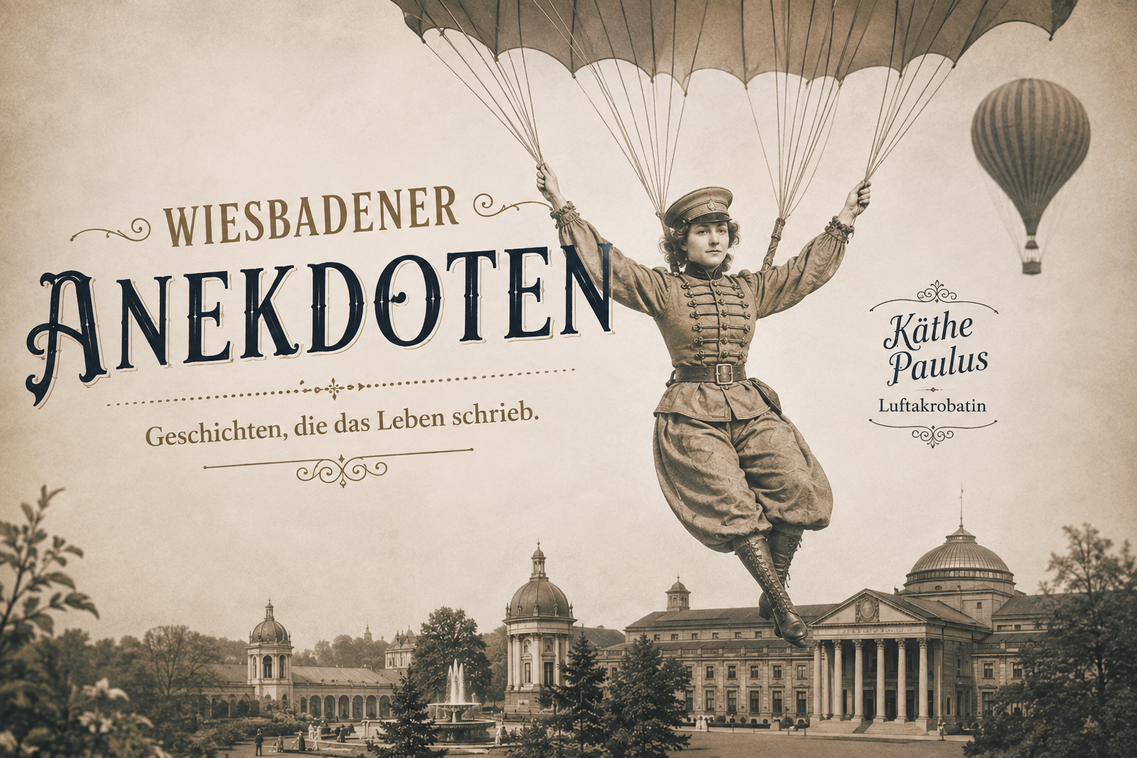
Käthe Paulus, the aerialist
June 1889 in Wiesbaden: Käthe Paulus crosses the street toward the spa gardens and, drawn by the shouts of others, notices a balloon floating in the sky. Her breath catches as a man detaches himself from the basket and glides to the ground with a parachute. This man is Herrmann Lattemann. Spa guests, onlookers, and strollers have gathered in the spa park specifically to witness him.
Käthe, who has come to Wiesbaden from Frankfurt with her mother for a spa treatment, approaches Herrmann Lattemann, who is busy repairing his balloon envelope. On the spur of the moment, he asks her if she’d like to take a ride with him sometime. Without hesitation, she says yes. Her enthusiasm for aviation is ignited from the very first moment—and not just for that. Herrmann and Käthe fall in love.
Käthe is a trained seamstress and initially mends his balloons. In 1893, she takes to the skies with him for the first time in Nuremberg. After he jumps out with a parachute, she brings the balloon safely back to the ground.
On June 6, 1894, the two open the “Aeronaut Season” in Wiesbaden: Käthe is already a real attraction thanks to her daring double parachute jump—first she jumps out of the balloon basket with a parachute, detaches herself from it shortly afterward, and opens a second parachute in the moment of free fall. The couple earns their living through these performances.
Käthe Paulus, who performs throughout Europe as “Miss Polly” in a fanciful uniform, a peaked cap, and harem pants, is considered the first German female skydiver, achieves world fame, and invents the parachute pack.
"Stadtgeflüster" Tip: Why does "Der Schweiger" turn his back on the Marktkirche? What quirky hobby did Wilhelm II have? And what did Goethe love about Wiesbaden? Find out all the answers—plus many more humorous stories and poems—on the "Stadtgeflüster" (opens in a new tab) public guided tour!


Quellgeflüster tip: Every Tuesday at 2 pm, Wiesbaden's tour guides show you their favorite places in Wiesbaden on a 90-minute tour (opens in a new tab). For Christine, this is the fountain temple on Kochbrunnenplatz. This is where the healing thermal water that has made Wiesbaden famous bubbles up, visible and alive for all to see. You can immediately sense Wiesbaden's deep, more than two-thousand-year-old history, whose roots go back to the Romans. The water tells of times long past, of baths and of today's use.