Smart City Supports World Design Capital 2026
Wiesbaden is part of the World Design Capital 2026...
... and demonstrates what design can achieve in a city. Under the motto “Design for Democracy. Atmospheres for a better life,” numerous projects are taking shape that combine creativity, participation, and a forward-looking approach.
Smart City Wiesbaden is also actively involved and supports three key initiatives that link digital innovation with urban quality of life. They enhance transparency, promote participation, and bring the city to life—both in the physical and digital worlds.
Visual Utopias for a Livable City

Smart City Wiesbaden also aims to get young people excited about digital topics of the future at an early age. We are therefore supporting the WDC project “Auf die PLÄTZE, los!” run by the Department of School Social Work for Children by facilitating AI workshops for elementary school students, in which they can rediscover their neighborhood and reimagine it using AI.
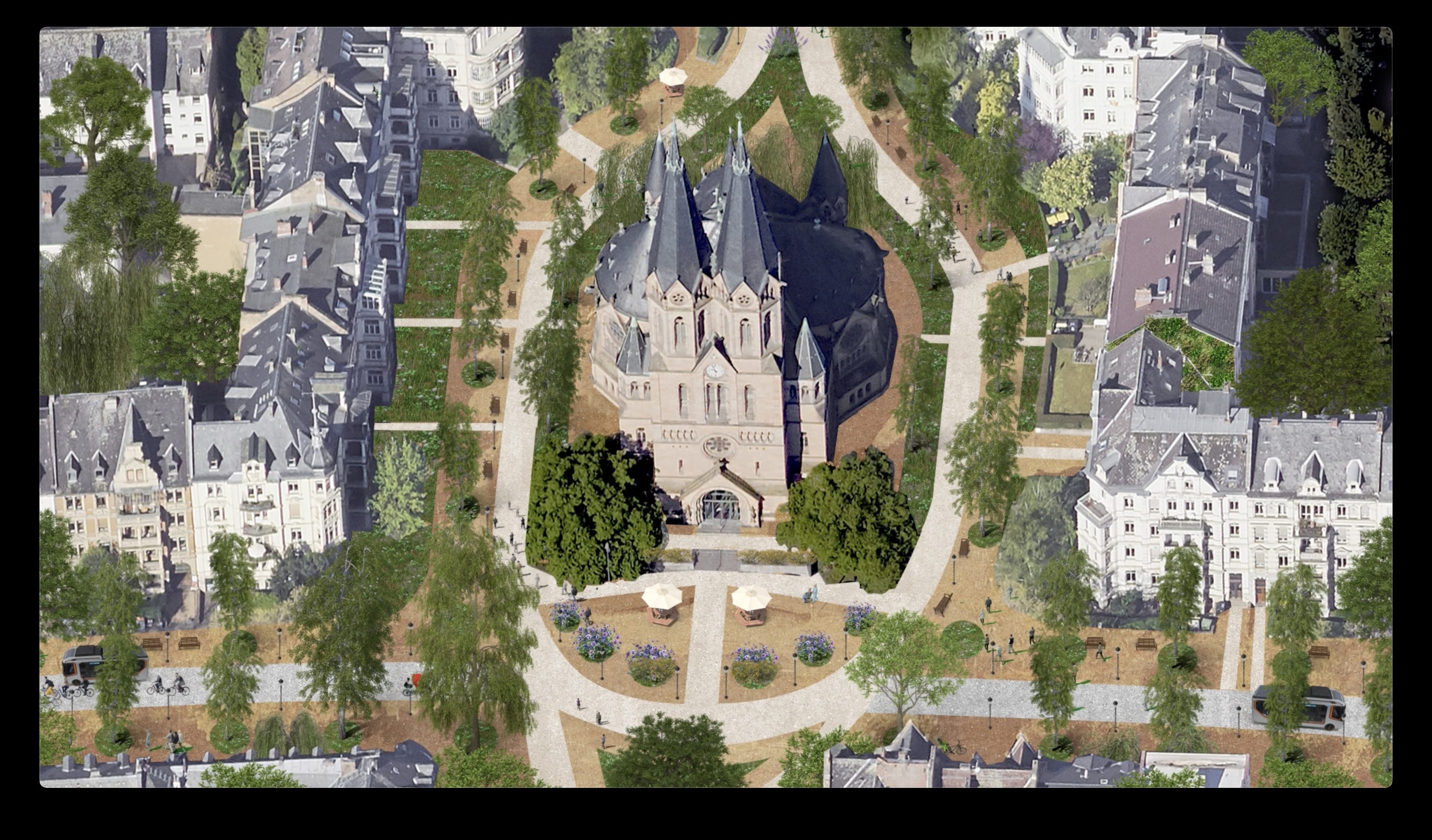
The collaboration with artist Jan Kamensky, who created an impressive visual utopia centered on the Ringkirche, was also the result of a partnership between Smart City and the school social work program for children. In this way, we combine creative inspiration with digital innovation—and bring the future to life for children.
Further information
"Ringkirche," a Visual Utopia by Jan Kamensky
In order to view the external content, you must enable it by clicking on the "Activate content" button. In doing so, the provider sets cookies and collects data on your usage behavior. You can revoke your consent at any time in the privacy settings (opens in a new tab) at https://www.wiesbaden.de/datenschutz.
Building bridges between Mainz and Wiesbaden
As part of its ongoing initiatives, Smart City is supporting the WDC project “Brückenschlag” by the Scholz&Volkmer agency.
As part of this project, the number of cyclists crossing the Theodor-Heuss Bridge, Kaiser Bridge, and Schierstein Bridge will be systematically counted and analyzed for the first time in the summer of 2026. The counts began during the campaign period of Wiesbaden’s STADTRADELN 2026 as a four-week test and comparison period. The campaign aims to encourage more people to commute by bike rather than by car between the neighboring cities during the project period in the summer. Counts are conducted via an app and permanently installed devices. The collected data will be analyzed, visualized in an engaging way, and made available to the interested public. Key findings from this temporary measurement campaign will be incorporated into the planning of the permanent Wiesbaden–Mainz bike expressway. The data reveals when and in which direction the bridges are used most heavily, as well as which of the three bridges is particularly important for cyclists.
Further information
Smart City Brings the World Design Capital to Life Digitally

The WDC projects in Wiesbaden can now also be experienced digitally through the Digital Twin.
Using a new storytelling tool, Smart City Wiesbaden connects more than 30 projects into interactive tours. A digital overview map shows where the projects are located in the city and the ideas behind them. Users can explore the locations virtually and learn more about the projects.
In addition to the WDC tour, there is another digital tour—for example, on the history of old department stores in the project “KONSUM und ICH – From Department Store to Shopping App”—and soon there will also be an overview map of significant sites of democracy in the “Hörmal Demokratie Audiowalk” by the Cicero agency.
In this way, Smart City Wiesbaden combines digital innovation with culture and showcases the city in a new light.
Further information
Contact us
Smart City Unit
Address
65189 Wiesbaden
Arrival
Notes on public transport
Bus stop Hasengartenstraße, bus route 27. Bus stop Weidenbornstraße/JUVZ, bus lines 3, 6 and 33.
Website
Information on accessibility
- Barrier-free access is available
- The WC is barrier-free