Museum and city center - what's possible?
The fourth sam DesignDialog 2026 was held at WerkRaum Wiesbaden and focused on museums in city centers. Guests from Frankfurt, Chemnitz, and Hamburg presented museums and concepts.
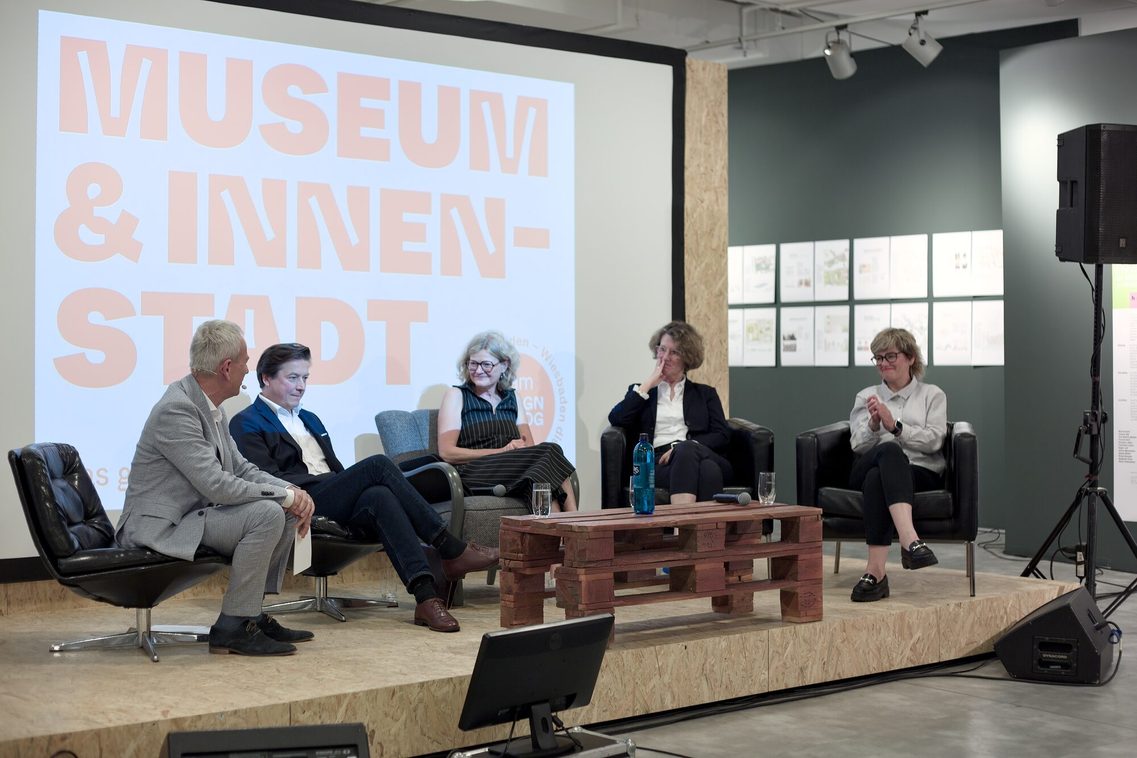
MUSEUM AND INTERIOR CITY - What's up?
sam DesignDialog 2026
What role can museums play in the future of our city centers? And how can they become places of encounter, identity, and participation? These were the questions explored at the fourth sam DesignDialog on June 10, 2026, at WerkRaum Wiesbaden in the former SportScheck building. About 85 guests attended the discussion in person.
The event took place as part of World Design Capital Frankfurt RheinMain 2026 and was organized by sam – Stadtmuseum am Markt in cooperation with the Wiesbaden Urban Development Corporation (SEG), the Wiesbaden Foundation, and RheinMain University of Applied Sciences.
Under the title “Museums and the City Center—What’s Possible?”, experts from Wiesbaden, Frankfurt, Chemnitz, and Hamburg discussed the importance of city museums for the development of vibrant city centers. “We want to develop visions of what a modern, contemporary city museum or regional museum could look like,” explained Sabine Philipp, director of sam – Stadtmuseum am Markt, in her opening remarks. She noted that the event deliberately sought to look beyond Wiesbaden.

On the panel, Dr. Doreen Mölders, director of the Frankfurt Historical Museum; Dr. Sabine Wolfram, director of the State Museum of Archaeology in Chemnitz (smac); and Prof. Dr. Rainer-Maria Weiss, Director of the Archaeological Museum of Hamburg and the Harburg City Museum, shared their experiences with modern museum concepts and new locations.
A key takeaway from the evening: Today, museums are understood to go far beyond their traditional role as exhibition spaces. They are places of trust, exchange, participation, and social dialogue.
For Dr. Doreen Mölders, breaking down barriers to access is a key priority—not only physical barriers, but cultural ones as well: “We will strive to establish the museum even more firmly as a social space, including within urban society,” emphasized the director of the Frankfurt Historical Museum.
The importance of museums for the development of city centers was also highlighted repeatedly. The panelists agreed that culture and urban development can reinforce one another. The examples from Chemnitz and Hamburg were particularly impressive. In Chemnitz, the former Schocken department store was successfully converted into an archaeology museum. Dr. Sabine Wolfram shared her experiences in Chemnitz: “Housing the museum in the former Schocken department store is a truly special success story. We have already received numerous awards for the building’s restoration in accordance with historic preservation guidelines (built in 1929–30), our modern exhibition design, and our corporate identity.”
In Hamburg-Harburg, “Planet Harburg,” located on the ground floor of a former Karstadt building, is developing into a new cultural attraction. Prof. Dr. Rainer-Maria Weiss, director of the Hamburg Archaeological Museum and the Harburg City Museum, aims to use this branch to create an accessible offering for all segments of society. His most successful archaeology exhibitions featured Lego and Playmobil figures. He says: “We don’t want to become an event machine, nor do we want to gather dust in an ivory tower.”
The discussion made it clear that former department stores offer unique opportunities for cultural uses. They are usually centrally located, familiar to many people, and feature large, flexible spaces. This allows them to become accessible venues for culture, education, and social interaction. Dr. Sabine Wolfram pointed to the experiences in Chemnitz: Buildings that were formerly department stores are places that people already know and associate with positive everyday experiences. This helps break down barriers and attract new groups of visitors.
The examples from Chemnitz and Hamburg demonstrated the potential that former department stores offer for cultural uses. Their central locations, the familiarity of the spaces, and large, flexible areas create ideal conditions for culture, education, and social interaction. As Dr. Sabine Wolfram emphasized, this helps break down barriers and attract new visitor groups.
The importance of a city museum for a city’s identity also played a key role. Dr. Alrun Schößler of the Wiesbaden Foundation is “deeply convinced that identity is rooted in history and that something can grow from this, which we can then shape together.”
For Wiesbaden, the evening impressively demonstrated the potential that a visible and centrally located city museum could unlock for the city’s community. The experts agreed: museums belong right in the heart of the city—where people meet, discuss, and shape the future together. And they certainly represent an economic factor in their own right.
In closing, Sabine Philipp emphasized the unique opportunity currently opening up for Wiesbaden: “Ten years in the basement for the state capital’s city history is enough. The state capital needs a visible cultural-historical museum in the city center—as a place of identification, encounter, and participation, and as a complement and counterpart to the museum axis on Wilhelmstrasse.”
The sam DesignDialog 2026 has shown that modern city museums do more than just preserve history. They provide a sense of direction, strengthen identity and social cohesion, and make an important contribution to the appeal of city centers. This requires visibility, accessibility, and a firm anchoring in the heart of urban life.
Cooperation
An event organized as part of World Design Capital Frankfurt RheinMain 2026 in cooperation with SEG, the Wiesbaden Foundation, and RheinMain University of Applied Sciences. WDC 2026 is supported by the State of Hesse, the City of Frankfurt am Main, and the Frankfurt RheinMain Cultural Fund.