Energy and greenhouse gas balance
Every three years, the city administration draws up a greenhouse gas balance sheet on behalf of the city council. The evaluation for the period from 2019 to 2023 is now available. According to the report, Wiesbaden was able to significantly reduce its energy consumption and thus also its emissions of climate-damaging greenhouse gases.
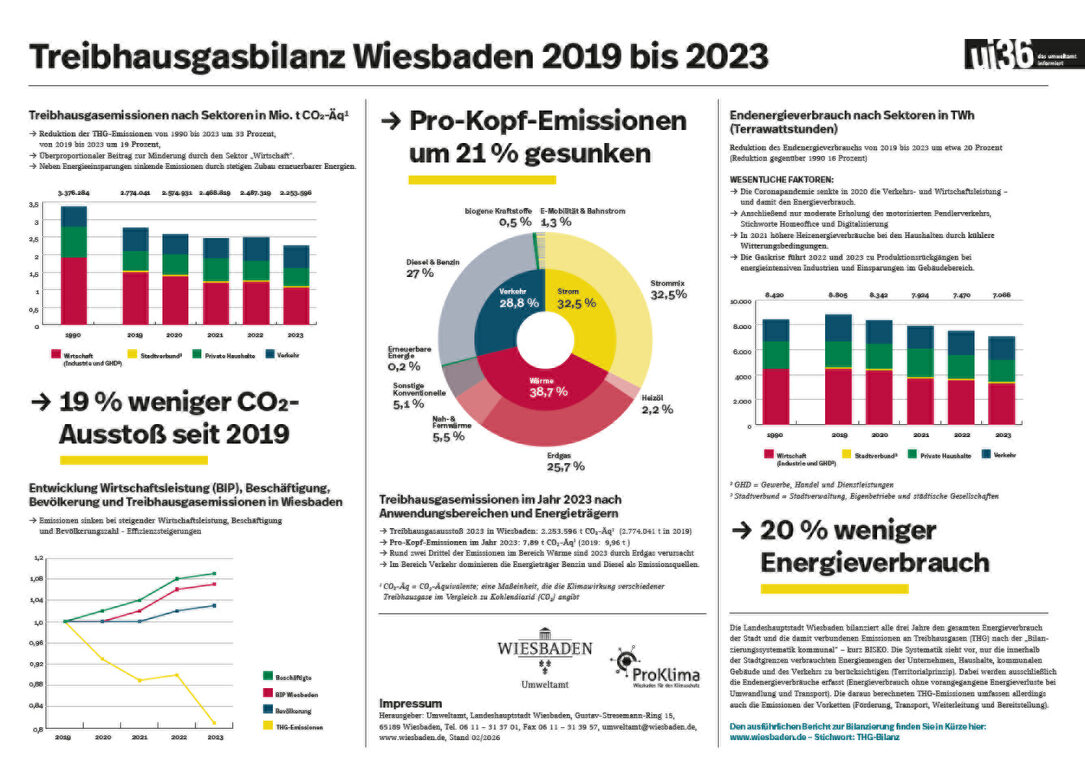
Emissions are expressed in terms of CO₂ equivalents (CO₂eq). All greenhouse gases are converted into CO₂ equivalents according to their climate impact in order to make them comparable.
The most important results at a glance:
- 19 percent reduction between 2019 and 2023
- 33 percent reduction in greenhouse gases since 1990 (international reference year for climate protection)
- Over 21 percent fewer emissions per capita since 2019
In 2023, a total of 2.25 million tons of CO₂ equivalents were emitted. This corresponds to around 7.9 tons per inhabitant – about two tons less than in 2019. With a slight increase in population, per capita emissions have thus fallen significantly.
The economy has reduced its emissions particularly sharply: compared to 2019, they fell by 29 percent. Private households also saved energy. Their consumption fell by 15 percent and the greenhouse gas emissions they caused by 10 percent. The transport sector was able to reduce its emissions by four percent. However, as other sectors have made greater savings, the relative share of transport in the city's total emissions is growing.
There are several reasons for this development. During the coronavirus pandemic from 2020 onwards, lower transport services and weaker economic activity led to lower energy consumption. Even after the pandemic, commuter traffic in particular remained below 2019 levels, partly due to more home office and digital forms of work.
The energy crisis of 2022 and 2023, resulting from Russia's war of aggression against Ukraine, had another major impact. The sharp rise in natural gas and electricity prices led to declines in production in energy-intensive industries and to savings in heating and electricity consumption in businesses and households. At the same time, more coal was temporarily used for electricity generation in 2022. Since the nationwide electricity mix is used as the basis for the balance sheet, this higher share of coal also had an impact on the Wiesbaden balance sheet. As a result, despite lower energy consumption compared to 2021, there was a slight increase in emissions in 2022.
In the long term, however, a clear trend is emerging: the continuous expansion of renewable energies has been reducing emissions from electricity generation for more than two decades. Renewable electricity is a key component of climate-friendly heating for buildings and electric mobility. It is therefore considered an important lever on the path to a largely climate-neutral energy supply.
Various data sources are combined for the balance sheet. These include consumption data on electricity, natural gas, and district heating from network operators, supplementary information on heating systems, and model calculations for the transport sector based on traffic counts. In addition, data from Deutsche Bahn for rail transport and from ESWE Verkehr for local public transport are also included.
The Environmental Agency will shortly publish a detailed environmental report with all the results of the energy and greenhouse gas balance and link to it here.