Nixi AI GmbH
Do you know this? You sit at the doctor's, tell him about your complaints and your doctor types. You ask yourself: Is he even listening to me? Nixi AI listens to the conversation and writes the documentation automatically so that the doctor can concentrate on you. Clinically proven: 82% less documentation time.
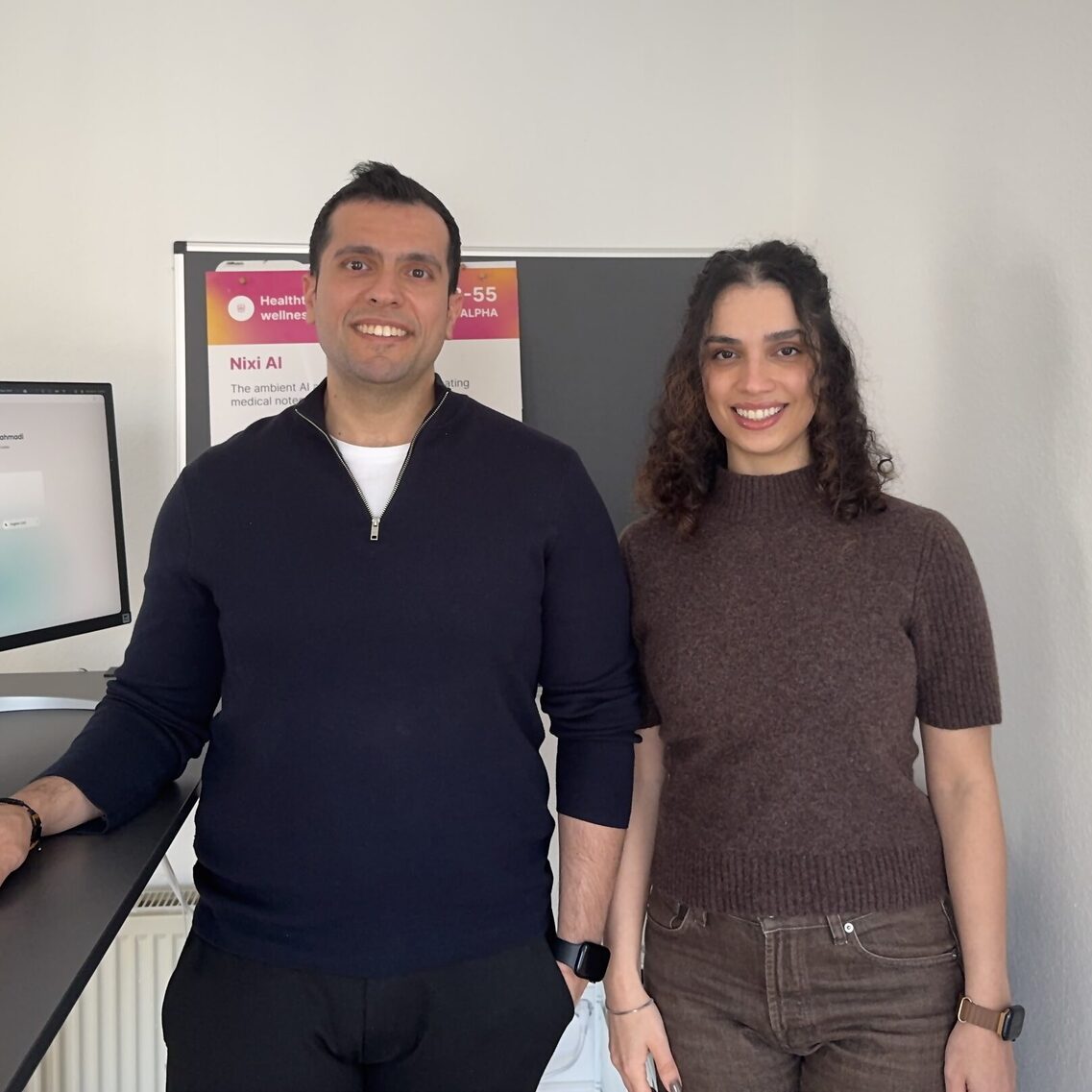
Company: Nixi AI GmbH
Founders: Mahsa Yarahmadi, Mehran Barzegari, Vamsi Krishna Kommineni
Date Founded: January 2026 (Preparations began in August 2024)
Industry and Company: Healthcare / Digital Medicine
What drives you? What is your motto?
Doctors should be doctors—not typists.
What is your startup about, and what makes it special?
When doctors type during a consultation, patients wonder: Is anyone listening to me? Nixi AI listens to the doctor-patient conversation and automatically generates complete medical documentation—specialized and in German medical terminology.
Unlike international products from the U.S. or Australia, Nixi was built from the ground up for German law, German billing codes, and German practice software. Our clinical study shows: 82% less documentation time. Made in Wiesbaden.
What are your first successes?
Our clinical study was published at EULAR—Europe’s largest rheumatology congress: 82% less documentation time at German university hospitals. We are funded by the BMBF’s EXIST startup grant. But the moment that moved us the most: When a doctor told us that he wouldn’t want to work without Nixi anymore—because he can finally just talk to his patients, and Nixi takes care of the rest.
What is your professional background?
We are pharmacists from Iran. Mahsa worked in hospitals, then at Boehringer Ingelheim and BioNTech. Mehran worked night shifts in pharmacies for years, then studied health economics and worked on digital health products at Boehringer. We came to Germany, built our careers—and then deliberately gave them up to found Nixi.
Our team is rounded out by our co-founder Vamsi Krishna Kommineni. He is an AI researcher and PhD candidate in computer science at the University of Jena. With his years of experience in machine learning, he brings deep technological expertise to the team and develops our own AI models at Nixi, specialized for German medicine."
What was the trigger for you to start your own company?
During his master’s thesis at Boehringer Ingelheim, Mehran realized why so many digital health solutions fail in practice: they give doctors even MORE forms and screens. Even more typing. Every new tool makes the problem worse, not better.
His idea: First, the documentation has to go—then everything else can work. Mahsa had experienced the same thing from the other perspective: shifts in hospitals where she saw patients telling the doctor something—and the doctor typing instead of listening.
At BioNTech, she proved that strict regulation and fast data solutions go hand in hand. In August 2024, we sat down together and wrote a business plan. In December, Mehran started programming—alone, without a team, without an office. In April 2025, we had our first pilot in a real doctor’s office.
Who advised you, who are your supporters and mentors?
The city of Wiesbaden—especially Ms. Bhardwaj from the Department of Economy and Employment—has supported and connected us from the very beginning. The Pioneer Lab at Fresenius University of Applied Sciences has accompanied us as an incubator. Stefan Roetzel from Hessen AI is an important mentor. Clinically, Dr. Moisidis-Tesch in Wiesbaden and Dr. Peer Aries in Hamburg gave us honest feedback. That was more valuable than any consulting advice. And last but not least: Mahsa’s father, an entrepreneur himself, who says during every late-night call: “Take the risk. I’ve got your back.”
How did you experience your first days as founders?
Freedom and fear at the same time. Suddenly, the two of us were sitting at the kitchen table with a laptop. When the first doctor said “yes,” we were overjoyed. We had tested the product a thousand times—it always worked. But in an actual doctor’s office? It didn’t work. We drove home, fixed it, drove back—still didn’t work. The “doctor’s office syndrome.” On the third try, it finally worked. And the doctor was thrilled.
What was your biggest challenge, and how did you overcome it?
Convincing German doctors that an AI is allowed to listen in on their patient consultations. The first “no” was tough. And the second. And the third. We realized: In medicine, you don’t earn trust through marketing, but through evidence. So we conducted our clinical trial and published it at EULAR—82 percent less documentation time. After that, the doctors didn’t say “No” anymore—they asked, “When can I start?”
How do you draw attention to your company? What’s your best marketing idea?
Our best advertising isn’t advertising—it’s our results. When we published the clinical study, doctors approached US. One pilot doctor even presented Nixi at a conference—without us asking him to.
Marketing works differently in medicine: When one doctor tells another, “This works,” that’s worth more than any ad. To this day, we haven’t spent a single euro on advertising.
How did you secure funding for your startup?
An EXIST startup grant from the BMBF, the Hessen Ideen grant, and Hessen AI—plus a lot of personal dedication. Our first funding round is currently underway.
What dream do you still want to realize?
That healthcare in Germany becomes more accessible, efficient, and humane for everyone—because technology takes over the administration, not the medicine.
Please complete the following sentence: If we had more time, we would ...... spend a weekend without a laptop in the countryside around Wiesbaden.
What is your special tip: What would you recommend to founders?
If someone says “no,” it doesn’t mean your idea is bad. It just means your product isn’t for everyone—and that’s completely normal. Don’t take it personally.
Further information
Department for Economy and Employment
Address
65183 Wiesbaden
Postal address
65029 Wiesbaden
Arrival
Notes on public transport
Public transportation: Bus stop Dern'sches Gelände, Luisenplatz and Wilhelmstraße; bus lines 1, 2, 4, 5, 8, 14, 15, 16, 17, 18, 20, 21, 22, 23, 24, 27, 30, 36, 45, 46, 47, 48, 262.
Telephone
- +49 611 313131
- +49 611 313922
Opening hours
The department can be reached by telephone from Monday to Friday from 8 a.m. to 4 p.m. at the number given in the contact field. It is recommended that you make an appointment in advance.