Open Data Wiesbaden
My city. My data: Wiesbaden is becoming more visible.


What is open data?
Data that moves
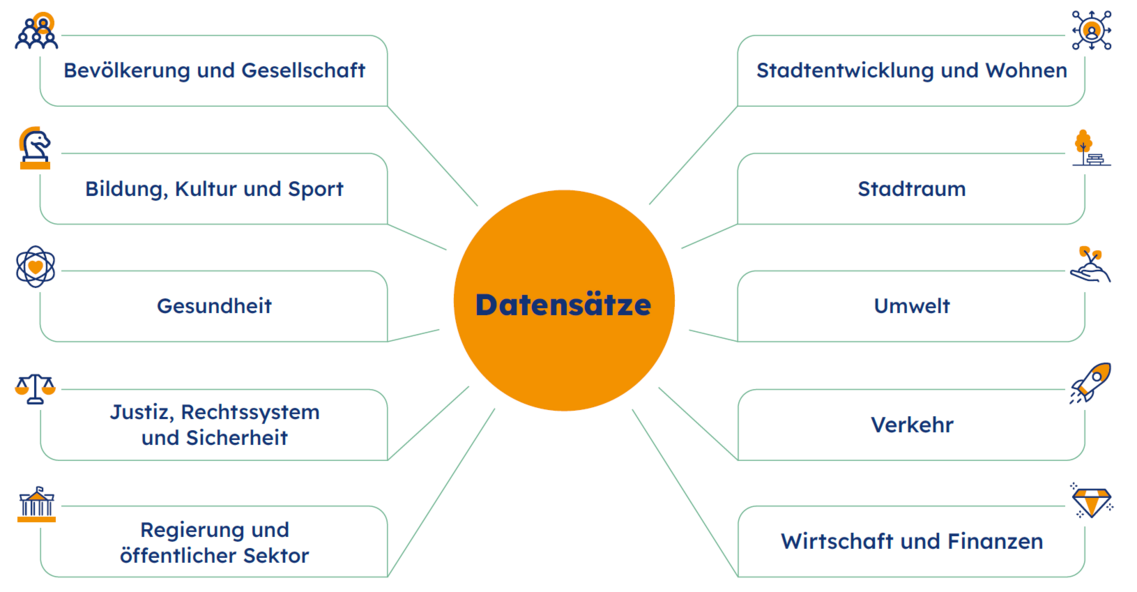
Open data is freely available, machine-readable information that can be used, processed, and shared by anyone. This includes, for example, statistical analyses, geodata, environmental data, and administrative information.
This creates new opportunities: greater transparency, innovative applications, and active participation by urban society. Open data facilitates access to public information and supports the development of digital solutions, data journalism research, research projects, and civic engagement. Open data is therefore a valuable raw material for new ideas – for business, science, and civil society.
What does "Open by default" or "Open per default" mean?
As open as possible, as protected as necessary.
In December 2023, the state capital of Wiesbaden adopted the principle of "open by default (opens in a new tab)" as a guiding political principle: all municipal data is considered open data unless there are legal, data protection, or security reasons to the contrary.
This reversal of previous practice makes Wiesbaden one of the pioneering municipalities in Germany. Instead of checking each data set individually to see "Can we publish this?", the question now is: "Are there reasons not to publish this data set?"
For whom is open data relevant?
For the urban community
For science and education
For journalism and media
For the local economy
For administration and politics
For all those who want to use data
Is open data secure and reliable?
How is personal data protected?
Which licenses are used for published data sets?
How does Open Data fit into the data infrastructure of the state capital Wiesbaden?
What is the city-wide data strategy all about?
What is the open data strategy of the state capital Wiesbaden based on?

Practical examples: learning to use open data
Step-by-step instructions for getting started
Want to work with open data but don't know where to start? Our examples show you step by step how to retrieve, process, and analyze data sets from the Open Data Platform.
The Jupyter Notebooks run directly in your browser—no installation or prior knowledge required.
No programming skills? No problem!
What is Binder?
What are Jupyter notebooks?
For local use
Try it out now (via Binder)
Introductory tutorial: Downloading and visualizing open data
sets (opens in a new tab) Duration: approx. 15 minutes
sets (opens in a new tab) Duration: approx. 15 minutes
Searching for open data sets with Python (advanced) (opens in a new tab)
Duration: approx. 20 minutes
We welcome your questions and suggestions via the contact options listed below.
Further links
- The open data platform of the state capital Wiesbaden (opens in a new tab)
- Open Data Guides
- Internship for students in the field of open data
- Wiesbaden - Facts & Figures
- Code examples & tutorials (Gitlab at OpenCode) (opens in a new tab)
- Open Data Hesse (opens in a new tab)
- City-wide data strategy
- City-internal data room
- Digital twin Wiesbaden
Contact & Support
The Open Data Officer of the State Capital of Wiesbaden
Address
65189 Wiesbaden
Postal address
65029 Wiesbaden
Arrival
Notes on public transport
Bus stop Statistisches Bundesamt; bus lines 16, 22, 27, 28, 37, 45, X26, x72, 262
Telephone
Information on accessibility
- Barrier-free access is available
- The WC is barrier-free