Reisinger facilities (formerly Reisinger and Herbert facilities)
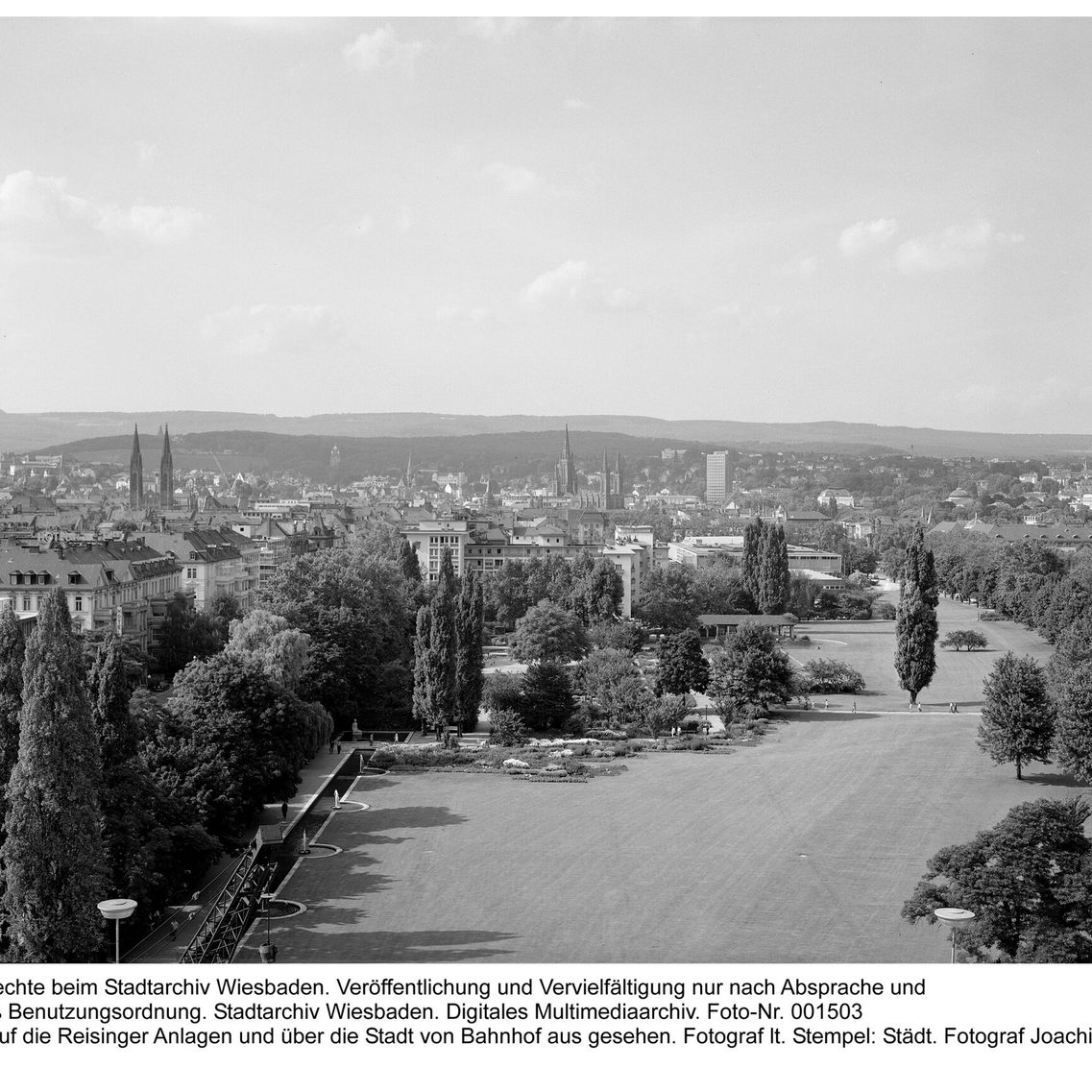
The Reisinger grounds opposite the main railway station (opens in a new tab) owe their existence to the generous donations of the merchant Hugo Reisinger (opens in a new tab) and the pharmacist Adam Herbert (opens in a new tab). A gas factory as well as the Taunusbahnhof, Rheinbahnhof and Hessische Ludwigsbahnhof were located on the site or in the immediate vicinity.
After the main railway station was built, these buildings were demolished and the area became an industrial wasteland. When Reisinger donated $25,000 to the city for a fountain in 1913, various sites were initially considered, but then the terrain of the former Salzbachtal was considered. Implementation was delayed by the First World War (opens in a new tab) and was only resumed at the end of the 1920s.

In 1931, landscape architect Friedrich Wilhelm Hirsch, architect Edmund Fabry, and sculptor Arnold Hensler emerged as the winners of a competition. The primary goal was to clear the site. In addition, a fountain was to be created that would symbolize the healing springs through jets of water “as if springing from the meadow floor.” A canal running alongside the main path ends at a water basin featuring Hensler’s kneeling marble sculpture of a spring nymph. The complex was opened to the public in 1932.
The remaining areas were used for sports fields and community gardens. In 1936, the decision was made to use the funds donated by the pharmacist Herbert to expand the Reisinger Park. The design of the park was once again entrusted to Friedrich Hirsch, while architect Ernst von den Velden created a colonnaded hall and Stuttgart sculptor Ludwig Spiegel created the monumental shell limestone sculpture of Europa on the Bull. The design of the park, with its pseudo-antique colonnaded hall, reflects Nazi ideology. In particular, the 1.5-metric-ton shell limestone sculpture incorporates typical stylistic elements of Nazi design aesthetics. The former Herbert Park thus also served, through its iconography, to represent the propagated sense of community within the local Nazi “people’s community.” The influence of National Socialism is already evident in its design, as the deliberately flat, static illustrative style—combined with the sgraffito technique—is intended to underscore the solid craftsmanship of this monumental painting integrated into the architecture. The “Europa Park”—or Herbert Park—represents an iconographic exception in Germany with its expansive “European agenda.” It was built in the year that the first official “European” depictions of German fascism appeared.
The new complex, featuring a colonnaded hall and a large body of water, was inaugurated on July 6, 1937. In addition to the donor, Adam Herbert, NSDAP Mayor Erich Mix—who had extended the invitation to the event—delivered a commemorative speech. The program was accompanied by the spa orchestra. In attendance were the city’s most important officials as well as high-ranking representatives of the NSDAP, the SS, the SA, the NSKK, the Hitler Youth, and the BDM.
After World War II (opens in a new tab), American troops used the area as a parking lot. Work to restore the park began in 1950. Adam Herbert provided additional funds for the construction of the Diana Fountain in front of the Rhein-Main-Hallen (opens in a new tab).
Today, the park is used as a place to relax and play and for open-air events. As part of the construction of an adjacent kindergarten and the Rhein-Main-Hallen, contaminated sites were remediated by removing the remains of the gasworks buried in the soil, and the historic green space, covering approximately 3.4 hectares, was restored in accordance with preservation guidelines.
The Historical Expert Commission—appointed by a resolution of the City Council in 2020 to review traffic areas, buildings, and facilities in the state capital of Wiesbaden named after individuals—recommended renaming the Herbert-Anlage due to Adam Herbert’s ties to the Nazi regime. The responsible Wiesbaden-Mitte Local Advisory Council followed the recommendation and decided on February 1, 2024, that the name “Herbert-Anlage” could be discontinued. The local council asked the municipal administration to incorporate the Herbert-Anlage into the adjacent Reisinger-Anlage to the south. The donor plaque should be contextualized.
On February 1, 2024, the responsible Wiesbaden-Mitte local council decided to remove Adam Herbert’s name from the Herbert Park and to integrate the Herbert Park into the adjacent Reisinger Park. This was implemented by a resolution of the municipal administration on March 24, 2026.
[This text was written in 2012 by Martina Clair Michel for the print edition of the Wiesbaden City Encyclopedia and revised and expanded in 2024 by Dr. Katherine Lukat.]
Literature
Franke, Nils M.: Expert opinion on the historical development of the Herbert-Reisinger-Anlagen Wiesbaden, contribution to the park maintenance work, Wiesbaden 2007.
Sigrid Russ, editor, Denkmaltopographie Bundesrepublik Deutschland. Cultural monuments in Hesse. Wiesbaden I.2 - City extensions within the ring road. Ed.: State Office for Monument Preservation Hesse, Stuttgart 2005 [p. 150 ff.].
Names in public spaces. Final report of the historical expert commission for the examination of traffic areas, buildings and facilities named after people in the state capital Wiesbaden, in: Schriftenreihe des Stadtarchivs Wiesbaden, Vol. 17. Wiesbaden 2023.