Precautionary boiling order for drinking water
During drinking water inspections near the Kurhaus, the bacterium Pseudomonas aeruginosa was detected. The results have been available since Friday, September 25. In the affected area, drinking water must be boiled before use until further notice.
Current information
(As of September 29, 2026, 11:05 a.m. Latest updates: Information on further developments and investigation results; revision of the page structure)
What happened?
During drinking water tests near the Kurhaus, the bacterium Pseudomonas aeruginosa was detected. The results have been available since Friday, September 25. Additionally, drinking water samples from the wider downtown area and all other city districts showed no abnormalities.
The next reliable test results are expected on Wednesday, September 30, or Thursday, October 1. Until then, the precautionary boil-water advisory for the affected areas remains in effect.
Pipes continue to be flushed, samples collected, and tests conducted. Based on the pending test results, a decision will be made regarding the next steps and a possible gradual lifting of the boil-water advisory. A general all-clear for the affected areas cannot yet be issued.
The city will provide updates on the current status via press releases and on this page, as well as announce when the boil-water advisory is lifted.
What should you do?
Drinking water in the area listed below must be boiled before use until further notice. This is a precautionary measure to protect public health.
You should bring the water to a rolling boil (to about 100 degrees Celsius) and then let it cool for about ten minutes before using it. This kills germs. Afterward, you can use the water as usual. Alternatively, you can use bottled drinking water.
What can happen if I drink unboiled water?
For healthy individuals, the bacterium Pseudomonas aeruginosa in drinking water generally does not pose an increased risk. However, for people with specific risk factors, it can lead to infections.
Which areas are affected?
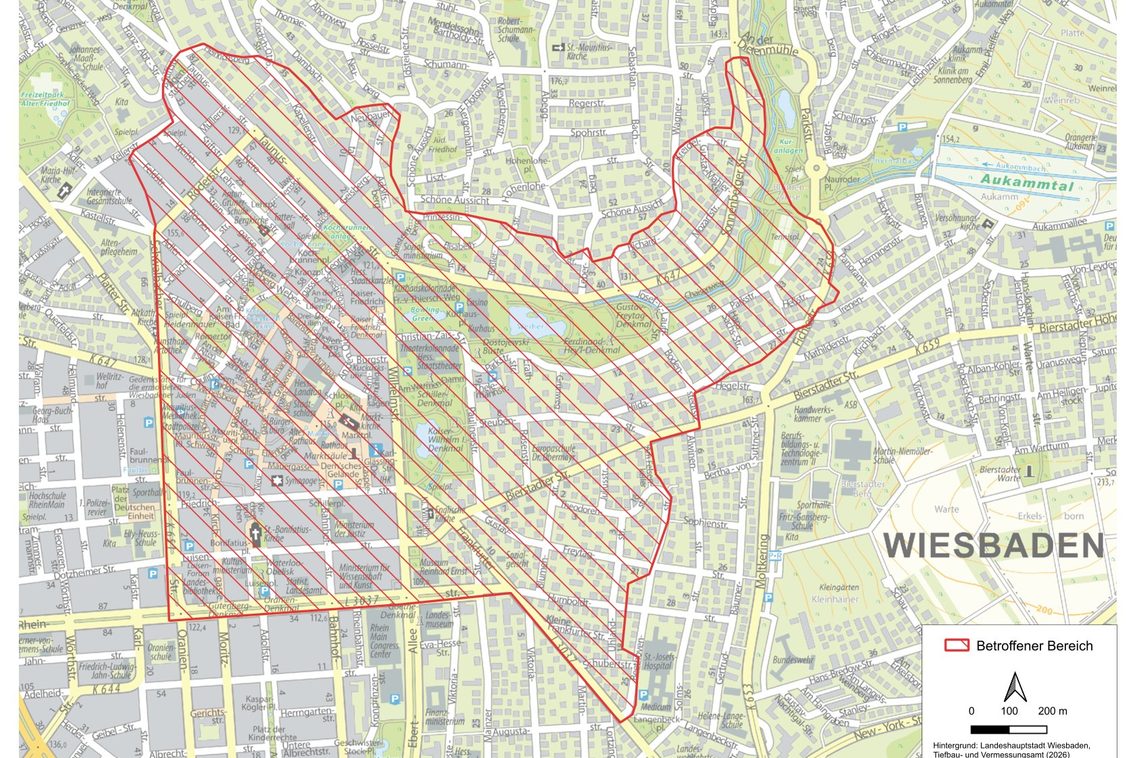
Currently, the precautionary boil-water order is in effect in an area surrounding the Kurhaus in downtown Wiesbaden. The affected streets are shown on the map and in the PDF attached to this press release (opens in a new tab).
When should I boil water?
You should boil water especially if you plan to use it for any of the following purposes:
- Drinking
- Making beverages (including ice cubes)
- Food preparation
- Washing fruit, vegetables, salad, or other foods
- Medical purposes (for example, cleaning wounds, nasal rinses)
- Brushing teeth
- Washing dishes by hand
- Water for sensitive pets
For certain groups of people with specific risk factors, additional recommendations apply, which are described below.
What other protective measures are advisable?
After washing, showering, or bathing, the ears—and especially the outer ear canal—should always be dried thoroughly, using cotton swabs if necessary. Open wounds should be covered with a waterproof dressing before coming into contact with water.
General information
Guidance for People with Risk Factors, Pregnant Women, and Children
Guidelines for Restaurants, Medical Practices, and Other Businesses
Who can answer my other questions?
At wiesbaden.de/leben-wohnen/feuerwehr-notfaelle/einsatz-praevention/faq-trinkwasser, (opens in a new tab) you’ll find many answers to questions about Wiesbaden’s drinking water system. For questions about the current boil-water advisory, please contact the City of Wiesbaden Water Supply Authority (WLW) at (0611) 7802201 or wasserqualitaetwlw-wiesbadende. You can also contact the Wiesbaden Health Department during business hours from 9 a.m. to 4 p.m. at (0611) 312828 and info-gesundheitsamtwiesbadende.
General information
How will I be warned in the event of a crisis?
Should a crisis occur, you will be alerted through various channels depending on the situation, such as sirens, mobile loudspeaker announcements, radio or television broadcasts, cell broadcast messages, and alert apps. We also provide information via press releases and on social media. For more information, visit the Public Alert page.
How can I prepare for crises and emergencies?
Extreme weather conditions, widespread power outages, fires: There are various crises that can occur unexpectedly. In the event of a large-scale crisis, emergency and response teams cannot assist all businesses, institutions, or citizens at the same time. Therefore, it is advisable to take your own precautions. On the Emergency Preparedness page, you can learn how to prepare for crises and emergencies.
Where can I find information about African swine fever (ASF)?
African swine fever (ASF) is not a crisis but a special situation. You can find information on this topic on the African Swine Fever page.
Who is responsible for disaster management?
Disaster management is the responsibility of the federal states. It is regulated by state laws. The state ministries of the interior are the highest disaster management authorities.
Counties and independent cities such as Wiesbaden, together with their specialized departments, form the lower-level civil protection authorities. The operational implementation of hazard mitigation thus takes place at the municipal level. Wiesbaden has established the Civil Protection Department within the fire department. On behalf of the mayor, it is responsible for crisis management as well as disaster and civil protection.
Concepts, plans, regulations, and recommendations for disaster control can be found in the Disaster Control Information Center of the Hessian Ministry of the Interior (opens in a new tab).