Special exhibition "Christian Dell (1893 to 1974) - From the silver can to the gold lane"
As part of the World Design Capital Frankfurt Rhine-Main, the sam – Stadtmuseum am Markt is dedicating an exhibition to one of the 20th century’s most important design pioneers—Christian Dell—through November 15, 2026.
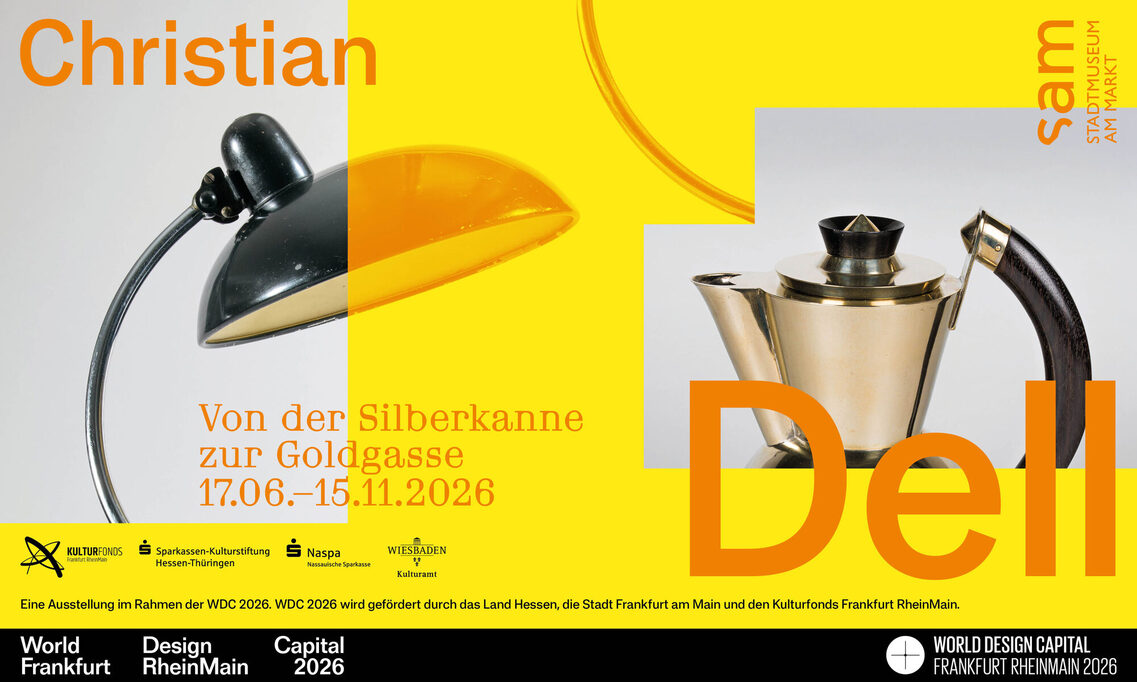
Design history with a Wiesbaden connection

Christian Dell is considered one of the defining figures of modernism. His designs—including the famous lamps from the “Kaiser Idell” series—are now regarded as icons of modern design. Less well known, however, is his connection to Wiesbaden: Dell spent the second half of his life in the capital of Hesse.
The special exhibition at sam—Stadtmuseum am Markt—was dedicated to the life and work of a designer who bridged the worlds of craftsmanship, the Bauhaus, and industrial production. From his early years as a silversmith in Hanau, through his time at the Bauhaus in Weimar, to his work as a teacher and designer in Frankfurt, the exhibition offered new perspectives on an extraordinary life journey.
On display were lamps, metalwork, photographs, sketches, and documents from various phases of his career. The exhibition focused not only on Dell’s well-known design classics but also on the ideas, materials, and networks of Modernism.
At the same time, it offered a fresh perspective on Christian Dell as a figure from Wiesbaden—and on the question of why his work remains known worldwide to this day, while his biography long remained in the background.
Between craftsmanship and modernity

Christian Dell began his career as a silversmith. Early on, he combined artisanal precision with an interest in new forms and materials. During his time at the Bauhaus in Weimar and later at the Frankfurt School of Art, he developed a design language that continues to have an impact to this day.
The exhibition traced this journey through selected milestones and objects. It explored workshops and art schools, industrial mass production, and creative experimentation. At the same time, it highlighted how closely design history, social change, and technical innovation were intertwined.
A special focus was placed on Dell’s relationship with Wiesbaden and the question of why, although his work is known worldwide today, he himself received comparatively little attention for a long time.
Christian Dell and Wiesbaden
After his successful years at the Bauhaus and the Frankfurt School of Art, Christian Dell lived in Wiesbaden for many decades. It was here that he spent the second half of his life—largely out of the public eye.
Photographs, documents, and biographical traces linked international design history with local places and personal milestones in his life.
This provided a new perspective on Christian Dell—not only as a modernist designer, but also as part of Wiesbaden’s city history.
What There Was to Discover at the Exhibition
- Icons of Modern Design
- Early silverwork and metal objects
- Photographs and documents from the Bauhaus milieu
- Insights into workshops and training centers
- Milestones in Christian Dell’s life in Wiesbaden
- Rarely seen designs and everyday objects
Publication and Accompanying Brochure
A publication accompanying the exhibition has been released by arnoldsche Art Publishers. The 280-page book, *Christian Dell*, presents the designer’s life and work through scholarly essays, large-format illustrations of his objects, and historical documents.
The book costs 48 euros and can be purchased at sam with cash.
The accompanying brochure “Christian Dell—From the Silver Jug to Goldgasse” by the Wiesbaden City Museum Foundation, published in conjunction with the special exhibition, can also be purchased at sam with cash or ordered by email.
Publications and gifts
Admission
Admission to the special exhibition “Christian Dell (1893–1974) — From the Silver Jug to Goldgasse” was six euros, with a reduced rate of four euros.
Discounts were available for students, apprentices, volunteers, people with severe disabilities, the unemployed, and holders of the Wiesbaden TouristCard, the Volunteer Card, the Spa Card, or a same-day ticket from THermine.
Free admission for children under 18 and students with valid ID
Accompanying program

Lectures, workshop formats and discussions
A diverse program of accompanying events complemented the exhibition with lectures, open workshops, and discussions on design, craftsmanship, and Bauhaus modernism. Guests from the fields of academia, design, and education provided insights into Christian Dell’s milieu and the relevance of his work today.
Families and children were able to get creative themselves in open workshops and put Bauhaus design ideas into practice.
Guided tours of the exhibition took place at the sam – Stadtmuseum am Markt. Lectures, demonstrations, and workshops were held at WerkRaum Wiesbaden (Langgasse 5–9).
Documents
We would like to thank our
partners: Museen Hanau | Staatliche Zeichen Akademie Hanau | Bolichwerke,
Sponsors: Kulturfonds Frankfurt Rhein Main | Cultural Office of the State Capital of Wiesbaden | Sparkassen-Kulturstiftung Hessen-Thüringen | Naspa Nassau Sparkasse
and other supporters:
Hessian Ministry of Science and Research, Art and Culture | Friends of the Wiesbaden City Museum
The exhibition was a project organized as part of WDC 2026. WDC 2026 was funded by the State of Hesse, the City of Frankfurt am Main, and the Kulturfonds Frankfurt RheinMain.
sam - City museum on the market
sam - Stadtmuseum am MarktStiftung Stadtmuseum Wiesbaden
Address
65183 Wiesbaden
Arrival
Telephone
Opening hours
Tue–Sun 11 a.m.–5 p.m.
Thu 11 a.m.–8 p.m.
Administration (mailing address)
Wiesbaden City Museum Foundation
Bierstadter Str. 1
65189 Wiesbaden