Regional plan
The regional plan serves to control spatial development. It determines how areas are to be used and forms the planning framework for the region. The state capital of Wiesbaden is part of the region and the South Hesse regional plan.
The regional plan is an important instrument in spatial planning. It stands between the State Development Plan (LEP) and the municipal land-use plans of the cities and municipalities. It defines objectives and principles for spatial planning and implements the requirements of the LEP in the region. The regional plan looks at the developments that are expected over the next ten years and helps to resolve conflicts between competing land uses. It shows where in the region certain uses have priority and where others are excluded. However, the regional plan does not go into detail and does not specify what happens on each individual plot of land.
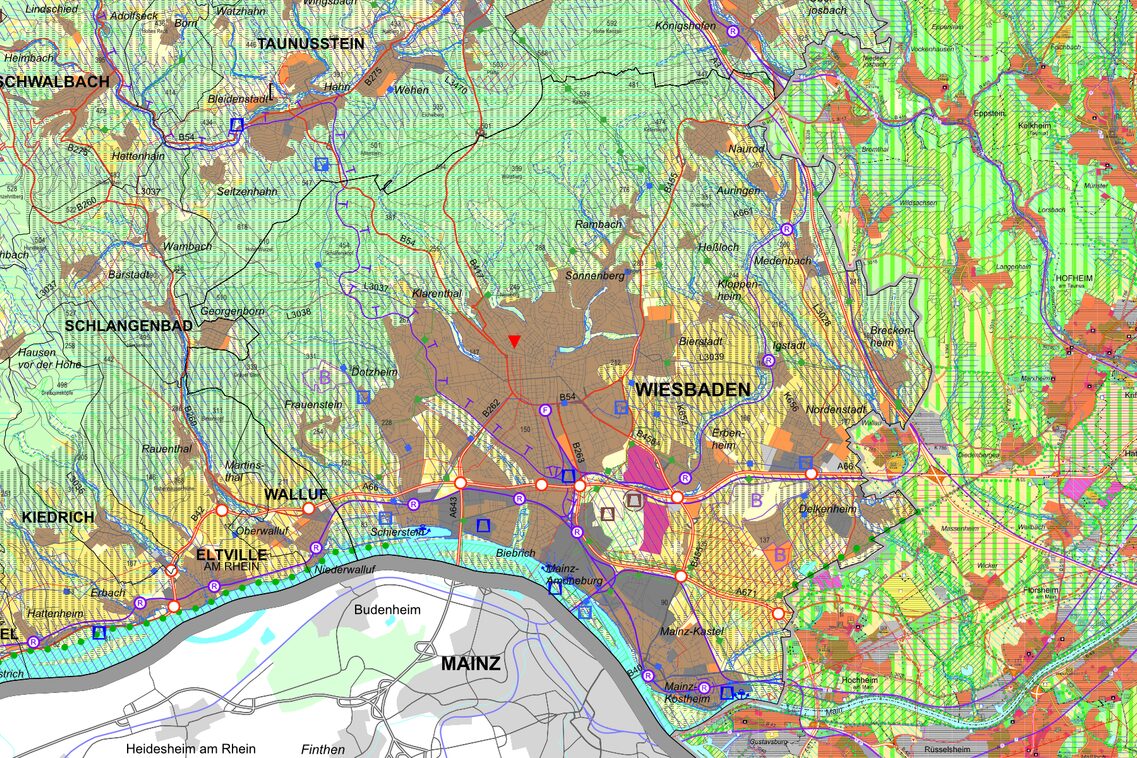
For the state capital of Wiesbaden, the South Hesse Regional Plan sets forth decisions regarding land use. It includes provisions regarding settlement patterns, open space, and infrastructure, and provides the city with guidelines that must be taken into account when drafting the land use plan and zoning plans. The provisions of the Regional Plan have varying degrees of binding effect: The objectives of regional planning are binding requirements that must be observed in all decisions with spatial implications. They may not be reconsidered at the level of municipal urban planning. The principles of regional planning must also be observed, but may be overridden in subsequent balancing decisions if other considerations are given greater weight.
The regional plan is generally a cross-disciplinary document that covers the entire planning region and links various sectoral plans. However, spatial and thematic sub-plans for specific topics may also be created. For the South Hesse planning region, the Thematic Sub-Plan for Renewable Energies (TPEE) from 2019 and its first amendment, effective since March 2020 and February 2022, respectively, are legally binding. The Thematic Sub-Plan for Renewable Energies designates priority areas for the use of wind energy and also sets out further provisions for other renewable energies such as solar energy, bioenergy, geothermal energy, and hydropower.PDF-File2,46 MB
Responsibility for drafting the South Hesse Regional Plan lies with the Darmstadt Regional Council, the highest planning authority. The South Hesse Regional Plan is currently undergoing a revision process. The South Hesse Regional Assembly’s initial deliberations on the 2024 draft/preliminary draft took place in February and March 2024. The draft of the South Hesse Regional Plan was made available for public review and comment from September 29 to November 28, 2025, as part of the first public review period. The city-wide statement from the state capital of Wiesbaden regarding the first public review was submitted on December 11, 2025, within the deadline via the Darmstadt Regional Council’s participation portal and is available here.
Documents
Up-to-date information on the planning process can be found on the website of the Darmstadt Regional Council. Until the new regional plan takes effect, the currently valid 2010 South Hesse Regional Plan remains in force.
Further information
Urban planning office
Address
65189 Wiesbaden
Postal address
65029 Wiesbaden
Arrival
Notes on public transport
Bus stop Statistisches Bundesamt; bus lines 16, 22, 27, 28, 37, 45, X26, x72, 262
Telephone
Opening hours
Please make an appointment.
Information on accessibility
- Barrier-free access is available
- The WC is barrier-free