Classrooms of tomorrow
In a participatory design process, students at HeLa Wiesbaden are developing spatial concepts for the classroom of tomorrow with the AMD's Interior Design course.
Project title:
Classrooms of the Future
Organizer:
AMD Academy of Fashion & Design Wiesbaden / Interior Design Program
Prof. Dr. Thilo Schwer
Kilian Schmitz-Hübsch, freelance architect
Helene Lange School Wiesbaden / UNESCO Project School, Club of Rome School, Experimental School of the State of Hesse School Development
Team: FLUG.VERSUCH
Tarek Aichah, Inga Frommelt, Fabian Veil
Brief description:
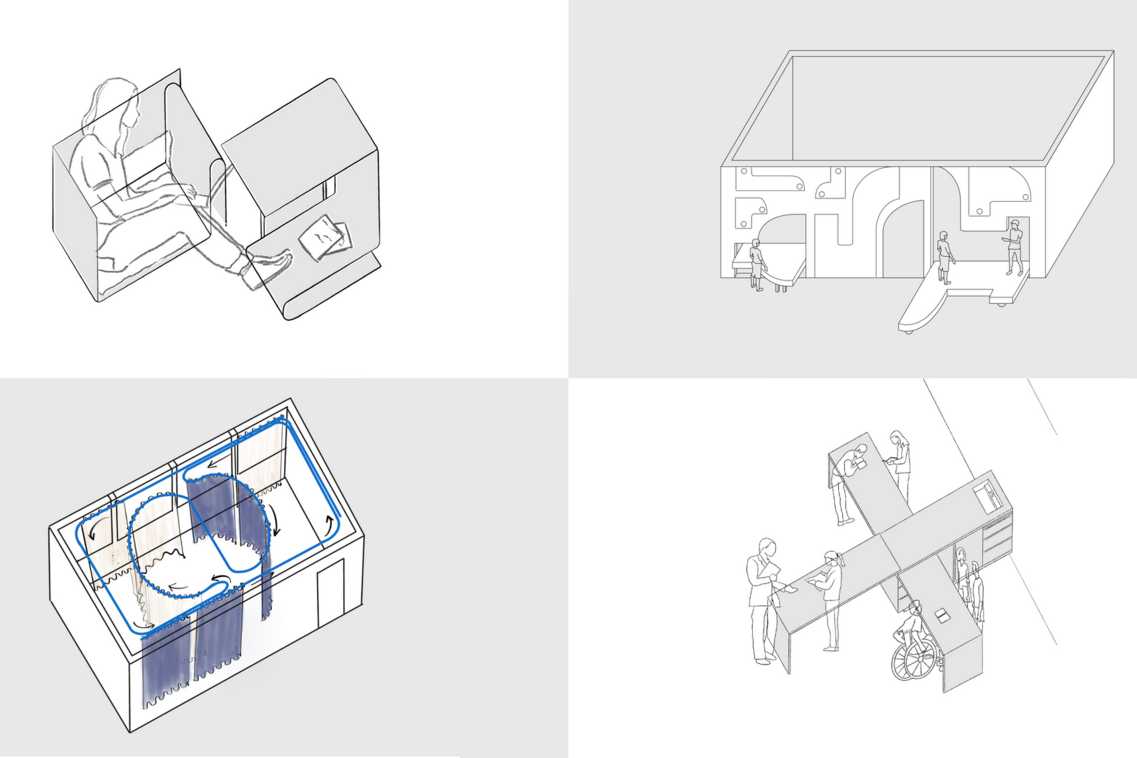
In a participatory design process, students from HeLa Wiesbaden are collaborating with the Interior Design program at AMD to develop spatial concepts for the classroom of tomorrow. Over three phases, they created spatial concepts and furniture that reimagine learning, participation, and daily life within the school environment.
How can a classroom be created that makes a democratic learning culture spatially tangible? The collaborative project between the Helene Lange School in Wiesbaden and AMD Wiesbaden—Interior Design program—is exploring this through a three-stage participatory design process that actively involves students.
- Exploring needs:
In a workshop, students work with designers to analyze the spatial conditions required for group work, self-directed learning, concentration, and quality breaks. The desire for inclusive solutions, physical activity, and safe spaces for retreat also plays an important role. - Developing and evaluating ideas:
Based on the identified needs, the students design concepts that are then discussed with the students. Through dialogue, ideas are refined through discussion, priorities are negotiated, and spatial atmospheres are tailored to the realities of learning and break times. - Evaluating designs:
The developed concepts are presented on-site and critically evaluated. These include, among other things, walls that open between the classroom, hallway, or adjacent room; a curtain system that creates flexible zones for group work and quiet learning islands; an inclusively designed mini-kitchen for lessons and breaks; multifunctional work tables with storage; mobile trolleys; seating cubes for relaxation; a spatial system for movement and retreat; a foldable mini-workstation that allows students with special needs both to retreat and to participate in the classroom community.
The result is a classroom with a versatile atmosphere that, through participation, negotiation, diversity, and freedom, invites students to shape their own learning spaces. As a model project, it aims to inspire other schools to rethink learning spaces in dialogue with students and designers.
Dates/period:
Development: 2025–2026;
Presentation expected in September 2026
Venue
WerkRaum Wiesbaden
Division/field of action:
School, Interior Design, Architecture
Further information
Cultural Office
Address
65185 Wiesbaden
Postal address
65029 Wiesbaden
Further information
Visitor entrance: Friedrichstraße 16
Arrival
Notes on public transport
Public transport: Bus stop Dern'sches Gelände, bus lines 1, 2, 4, 5, 8, 14, 15, 16, 17, 18, 21, 22, 23, 24, 27, 262, 45, 46, 47, 48, E, N2, N4, N5, N9, N10, N11, N12, X26.
Telephone
- +49 611 313640
- +49 611 313961
Website
Opening hours
Monday to Friday from 9 a.m. to 5 p.m., Wednesday from 8 a.m. to 6 p.m.