WerkRaum Wiesbaden in September
As part of the World Design Capital Frankfurt RheinMain 2026, the WerkRaum has served as an open forum for WDC projects, dialogue events, and other activities from May 2 through October 31, 2026. The sam—Stadtmuseum am Markt is also participating with individual events and the “Transparent Museum.”
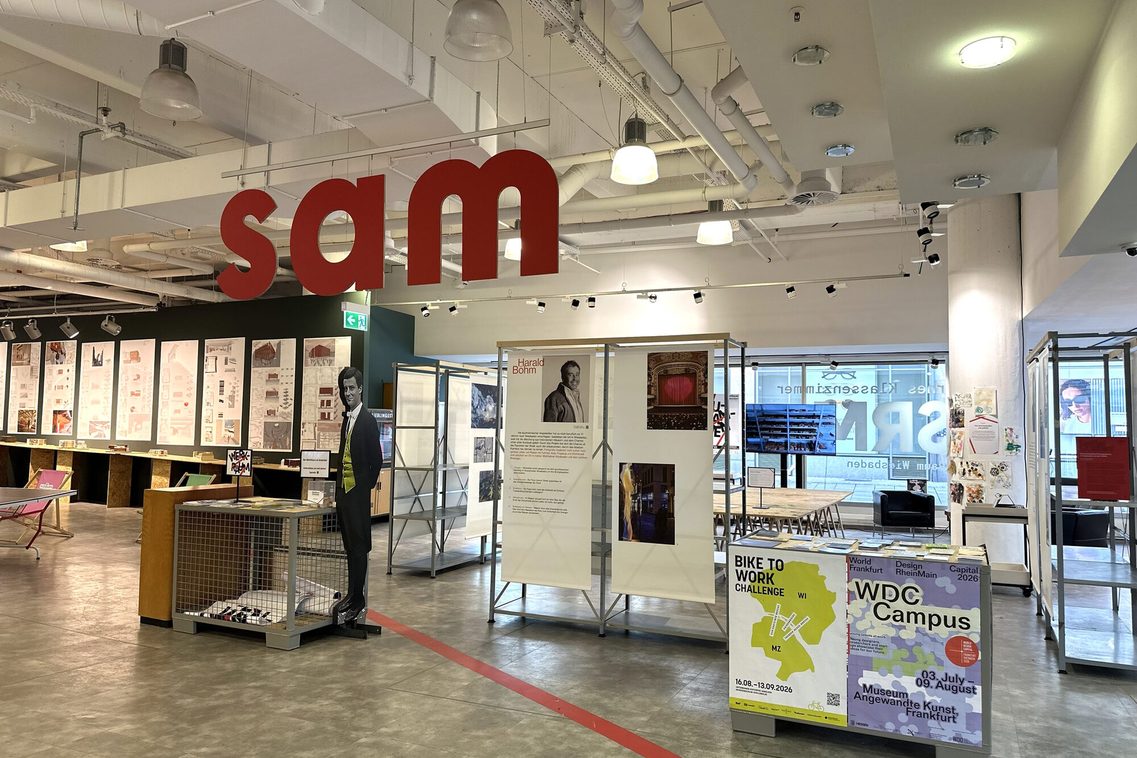
WerkRaum Wiesbaden in September: City History in Motion
City history never stands still. In September, WerkRaum will explore this theme from various perspectives: To mark the 10th anniversary of the sam, the “Gläserne Museum” will continue to offer a behind-the-scenes look at how exhibitions are created and the stories the museum has told over the past ten years. With the monthly theme “In Motion,” the focus is also on Wiesbaden’s streetscapes and the mobility of today and tomorrow. A diverse program of exhibitions, lectures, discussions, and open studios will accompany the month of September.
Events in September
Accompanying Program for the Special Exhibition “Christian Dell – From the Silver Pitcher to Goldgasse”


Tuesday, September 29, 6:00 p.m. | 10 Years of sam | Gläsernes Museum at WerkRaum
“Christian Dell in the World of the Hanau Academy of Art” | Lecture
The metal workshop at the Bauhaus in Weimar, led by master craftsman Christian Dell, is considered the cradle of modern industrial design. Without Christian Dell’s roots and training in Hanau, the city of the Brothers Grimm, this success story would not have been possible.His education at the Hanau Drawing Academy, founded in 1772, led Christian Dell to become one of the leading figures in modern design. His life’s work remained closely connected to the city of Hanau well into 1948.
Beate Alice Hofmann, collection director of the Hanau Municipal Museums, curated the first solo exhibition on Christian Dell’s work in 1996, thereby laying the foundation for subsequent research.
The lecture sheds light on the Hanau Academy of Drawing as a training ground for future leaders at the beginning of the 20th century and the influence Hanau had on Christian Dell’s creative work.
Today, the exhibition at the sam – Stadtmuseum am Markt is open until 6 p.m.
Further information

Wednesday, September 30, 2:00–4:00 p.m. | 10 Years of sam | Glass Museum at WerkRaum
What exactly does… Joana, a research project assistant, do at the museum?
How do the right objects actually end up in an exhibition? Joana offers insights into the museum’s research projects and shows how the search for suitable exhibits can turn into a detective-style investigation—from researching and tracking down to actually finding them.

Wednesday, September 30, 4–8 p.m.
How Color Shapes Spaces and Connects
with People: A Hands-On Workshop for Tradespeople and Finishing Professionals on Consultation, Spatial Impact, and Design
Successful color design doesn’t begin with choosing a shade, but with understanding the people who use and experience the spaces.
In the inspiring setting of the WDC project WerkRaum Wiesbaden, tradespeople and applicators are invited to experience how color, materials, and spatial impact come together to create compelling design concepts. Using professional consulting methods and the new Caparol Design Toolkit, participants will learn how to confidently advise clients and develop suitable color and material concepts. What they learn will be put into practice immediately during the workshop.
Focus on the event’s content and added value: practical methods for design consulting, a better understanding of color and spatial effects, and the development of your own design concepts.
Registration information is available at farbdesignstudiocaparolde.
Through October 31: 10 Years of sam | Glass Museum

The SAM as a Glass Museum at WerkRaum
For the past ten years, sam—Stadtmuseum am Markt has been telling the story of Wiesbaden in the Marktkeller. In its anniversary year, the museum itself becomes the subject of an exhibition: In the WerkRaum, highlights from past exhibitions, posters, photographs, and films look back on ten years of sam. Lectures, open studios, and behind-the-scenes glimpses invite visitors to rediscover the museum and its collections.

Hot! Springs! – A Participatory Photo Exhibition | September 25, 2024, through March 2, 2025 | sam
The sam – Stadtmuseum am Markt is presenting a selection from the exhibition *Heiße! Quellen!*—a participatory photo exhibition organized in 2024 in collaboration with the HSRM and Wiesbaden residents. “Hot! Springs!” is to be understood in a figurative sense: Armed with cameras, the participants roamed the streets in search of places that symbolically radiate special energies. The resulting photo series, supplemented by personal comments, offer unique insights into Wiesbaden from individual perspectives.

The J.J. Höppli Collection in Wiesbaden | September 11 through October 9, 2022 | Crypt of the Marktkirche, Wiesbaden
We honor the man whose terracotta ornaments and architectural sculptures in the Historicist style shaped the appearance of numerous buildings in Wiesbaden beginning in the mid-19th century. At the Gläsernes Museum, we are showcasing excerpts from the exhibition *The Estate of J.J. Höppli in Wiesbaden*, which was on view in 2022 in the crypt of the Marktkirche. On August 28 and October 2, the sam’s conservator will demonstrate how J.J. Höppli’s architectural ornaments are prepared for exhibitions.

Favorite Pieces
Every month, visitors to the sam select a favorite object from the museum’s collection, which is then displayed in the permanent exhibition. In the Glass Museum, we display a selection of these as object tiles. Every object has a story behind it—what’s your connection to it? We’re collecting your memories, associations, and stories on colorful postcards.
WerkRaum Wiesbaden | Focus on “In Motion”
One of the big questions for the future is: How do we get around, and in what spaces? Mobility determines our ability to participate. It affects environmental responsibility, social justice, and quality of life in equal measure. Mobility moves us both literally and figuratively. How do we want to get around our city in the future? What role will public transportation, bicycles, cars, or new forms of mobility play?
Exhibitions

September 7–30 | Exhibition: “Everyday Architecture—Wiesbaden’s Street Spaces Between Traffic, Daily Life, and Shifting Perspectives”
Everyday architecture and street spaces are experienced in different ways each day—on foot, by bike, on the bus, or in a car, whether moving slowly or quickly. Rarely are these architectural masterpieces; rather, they are ordinary supporting elements that serve as the backdrop for movement, traffic, and the experience of the city. This mostly unassuming architecture largely shapes the character of Wiesbaden.
The exhibition presents different perspectives on these familiar spaces—the view from a window onto the street and the unfamiliar view from an airplane, which reveals familiar places in a new light.
On display are photographs by students from the Department of Architecture and Civil Engineering at RheinMain University of Applied Sciences, as well as photographs by Berlin-based architectural photographer Maximilian Meisse. The exhibition is enriched by aerial photographs by Erika Noack.
A reading and play table offers opportunities to explore and engage playfully with Wiesbaden’s everyday architecture.
Exhibition "KONSUM and ICH"

Through October 31
The pop-up exhibition "CONSUMPTION and ME – From Department Stores to Shopping Apps" explores the relationship between consumption and us—and our democracy—from the early days of department stores to current issues surrounding online shopping, sustainability, and social participation.
It is both a history museum and a future lab: thus, it not only looks back but also invites visitors to participate and reflect. Together, visions for the future of consumption are to be developed and discussed.
Project partner: Janine Seitz, futurist.

September 1–30 | Exhibition: Video “Care Without A Capital C, 2021.”
*Care Without A Capital C* revolves around a massage in a professional auto repair shop. Cars and bodies, which normally move through public space, come to a standstill here to be cared for. The video’s soundtrack underscores the sometimes absurd tenderness that arises from the contact between human and mechanical bodies. Through the juxtaposition of mobility and stillness, the work develops a poetic reflection on the prerequisites of movement.
The auto repair shop takes on a dual function as a place of work and regeneration. Within the act of repair lies, at the same time, a moment of inner emotion. What happens to us when we step out of the flow of everyday movements—the streams of people in pedestrian zones or the avalanches of cars on the streets—and enter a space of stillness? The workshop becomes an in-between space where movement does not take place visibly, but is prepared, enabled, and reimagined.
In the context of WerkRaum’s September theme, “In Motion,” Care Without A Capital C offers an unusual perspective on mobility. Artist Anne-Louise Hoffmann’s work focuses not on speed or locomotion, but on their prerequisites: care, maintenance, support, and regeneration. She reminds us that people—as well as machines—need moments of pause in order to keep moving forward. For the brief duration of the video, an imaginary place emerges that blocks out the hustle and bustle of the city and invites us to reconsider mobility as an interplay of movement, stillness, and care.
Installations

September 7 – October 31 | Installation “Superblock in Hesse”
Since 2022, the Superblock initiative in the Rheingauviertel has been challenging the habitual use of public space. Why does the design of an urban neighborhood continue to be guided by the needs of (stationary) car traffic—despite the climate crisis, despite the loss of safe routes to school and street spaces that allow children to explore on their own, and despite the impact on urban aesthetics and atmosphere?
A spatial installation highlights the absurd amount of space taken up by elements designed to regulate and deter motor vehicle traffic in an already severely limited public space. The accumulation of these small barriers often lacks any design connection to their urban surroundings and offers passersby—whether young or old—no immediately perceptible added value.
A video featuring interviews offers further ideas for a shared, inclusive future in public space.
August 10 – September 30 | “Bike-to-Work Challenge” Installation
Cycling boosts energy, reduces stress, and is good for the environment. The “Brückenschlag Mainz-Wiesbaden” project aims to ensure that, by the summer of 2026, significantly more people commute to work by bike instead of by car.
Over the course of one month, cyclists are encouraged to cross the three main bridges as often as possible. Counts will be tracked via an app and permanently installed devices. Companies will compete against each other in teams. The collected data will be used to plan a permanent express bike route. A permanent high-speed bike route would primarily serve as a flagship project for the entire region, making the connection between the two state capitals more sustainable and faster.
Location: Mainz and Wiesbaden: Public bike paths and streets; MAK Frankfurt: Drawing machine with a virtual representation of the routes traveled.
The creative agency for digital brand management serves clients ranging from international brands to small NGOs. With over 650 awards to its credit, the agency regularly receives national and international recognition. In addition to creating content and campaigns for clients, it also implements its own projects with a sociopolitical focus. In line with the agency’s own sustainability strategy, “Shared Value,” it develops products such as a CO2 app that encourages users to reduce their daily CO2 emissions.
WerkRaum Wiesbaden - Open for your ideas!
WerkRaum Wiesbaden
Langgasse 5–9
65183 Wiesbaden
Hours:
11 a.m. to 7 p.m. on weekdays
, 11 a.m. to 8 p.m. on Thursdays
, Sundays by appointment
WerkRaum Wiesbaden is a project organized as part of World Design Capital Frankfurt RheinMain 2026. WDC 2026 is supported by the State of Hesse, the City of Frankfurt am Main, and the Kulturfonds Frankfurt RheinMain.
Contact us
sam - City museum on the market
Address
65183 Wiesbaden
Postal address
Bierstadter Straße 1
65189 Wiesbaden
Arrival
Notes on public transport
Public transportation: Stops Friedrichstraße and Dern'sches Gelände, bus lines 1, 2, 8 and 16.
Telephone
Website
Opening hours
Opening hours in the Marktkeller: Tuesday to Sunday from 11 am to 5 pm, Thursday 11 am to 8 pm.
Admission prices
Admission to the permanent exhibition is free.