Under the oaks" memorial
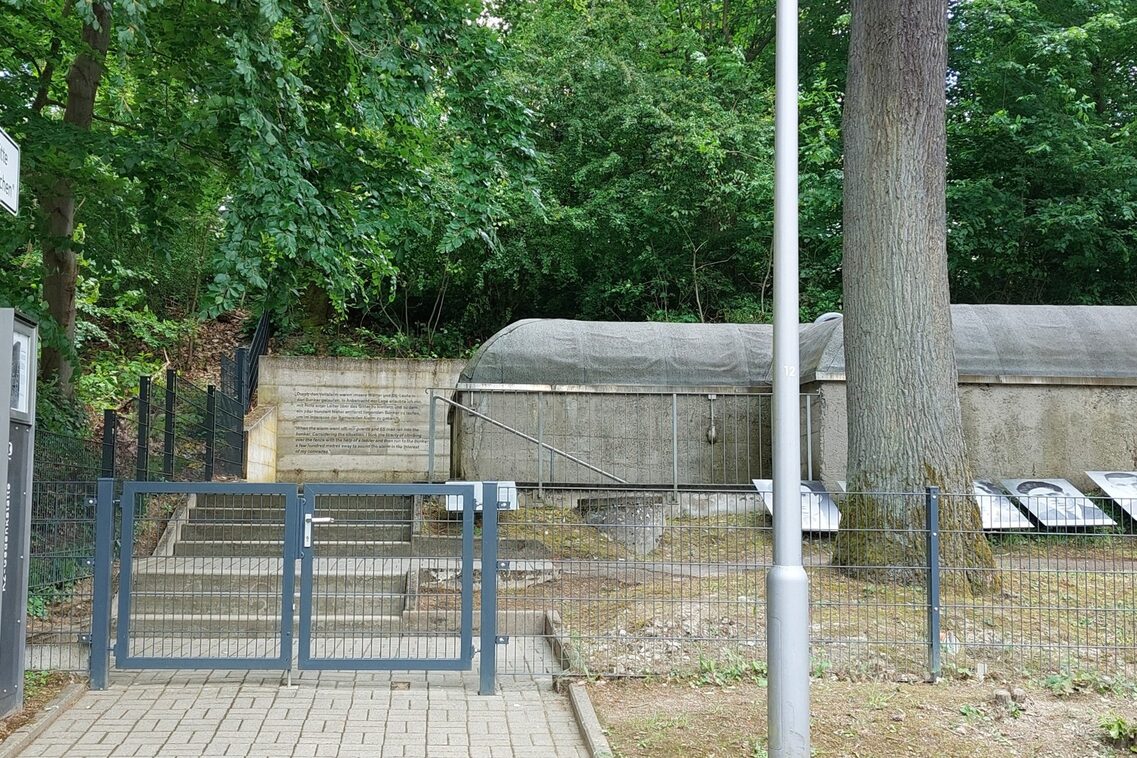
The "Unter den Eichen" memorial site commemorates the Wiesbaden subcamp of the SS Hinzert special camp/camp at the location of a former bunker that concentration camp prisoners had to build for the SS.
History of the place
The memorial is located below the former riding and tournament grounds known as “Unter den Eichen,” where the Wiesbaden satellite camp “Unter den Eichen” was established in the immediate vicinity. Administratively, this camp was part of the SS Special Camp/Concentration Camp Hinzert in the Hunsrück region. The memorial site comprises a former command bunker and its surrounding area.
The satellite camp had been established after Allied air raids on German territory had intensified dramatically since 1942. Consequently, the SS felt compelled to establish better-protected alternative quarters for its offices on the outskirts of the city. To this end, it requested prisoners from the SS Special Camp/Concentration Camp Hinzert. The first group of about 50 men arrived in March 1944.
The Wiesbaden satellite camp “Unter den Eichen” consisted of five simple wooden barracks and was surrounded by a barbed-wire fence. A maximum of 100 prisoners were interned here. Most of them were Luxembourgers, but there were also Frenchmen, a Dutchman, a Belgian, and a German imprisoned here.
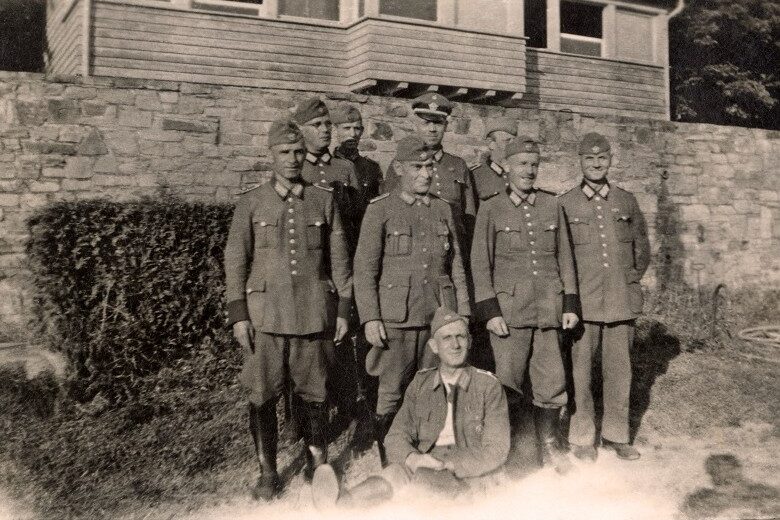
The camp was under the control of the SS and was guarded by police reservists. Due to the institutional ties between the SS and the police that existed from 1936 onward, members of the Schutzpolizei were assigned to guard the prisoners at the Wiesbaden satellite camp. The guard detail consisted of police officers who had been seconded to the “Higher SS and Police Leader for the Rhine/Westmark.” These were apparently mostly older police reservists, as their younger colleagues had been drafted into military service.
The use of prisoners for “war-essential tasks” had been the main objective of SS camp policy since the winter of 1941–42. For the temporary quarters of the Wiesbaden SS offices at the “Unter den Eichen” tournament grounds, prisoners from the satellite camp were to build office spaces, a dormitory for female SS auxiliaries, and a bunker. The camp commander of the Wiesbaden satellite camp was SS-Hauptsturmführer Friedrich Leber (1896–1967).

In the command bunker, SS officers and police guards found shelter from air raids. The prisoners, however, were not allowed access to it. During air raids, they had to seek shelter in bomb shelters and remain within the barbed-wire-fenced camp. Due to this lack of protection, Joseph Mayer, Prosper Schmitz, Nicolas Lanners, Albert Roilgen, Nicolas Oswald, and Alphonse Weber died during a bombing raid on the “Unter den Eichen” site on December 18, 1944.
They were buried at the Wiesbaden South Cemetery. Their fellow prisoners attached name tags to the coffins so that the dead could be identified later. In 1946, their remains were transferred to Luxembourg.
As the U.S. Army approached Wiesbaden from the direction of Mainz in March 1945, the “Unter den Eichen” satellite camp was to be dissolved and the prisoners transferred to Frankfurt-Heddernheim. The SS referred to this as an “evacuation.” Fear of being shot grew among the prisoners. The SS cleared out their offices, and on March 23, the prisoners were forced to set out for Frankfurt am Main under police guard. Some prisoners managed to escape during the camp’s dissolution.
The order to shoot the prisoners from the Wiesbaden concentration camp satellite camp upon their arrival in Frankfurt am Main was not carried out. Instead, the police officer in charge sent the group onward toward Friedberg. The concentration camp prisoners were liberated by the U.S. Army in Assenheim. Before they could return home, the men regained their strength with American assistance. Forced labor and malnutrition had left their mark. The survivors of the Wiesbaden satellite camp spent several weeks on the grounds of IG Farben in Frankfurt, where thousands of “displaced persons”—former forced laborers and concentration camp prisoners—were housed.
The memorial
Most of the barracks at the satellite camp and the SS office had already been demolished by the end of 1945. They were used to provide building materials. The area around the bunker was left to its own devices and became overgrown. It was former prisoners who drew attention to the significance of the site in the 1970s. A member of Bündnis 90/DIE GRÜNEN active in Wiesbaden city politics advocated for the preservation of the bunker. The Wiesbaden “History Workshop,” a citizens’ initiative, was ultimately commissioned to research the Wiesbaden satellite camp. In 1991, the municipal government of the state capital of Wiesbaden had the bunker—as the last remaining structure—converted into a memorial by establishing a permanent exhibition. It was inaugurated on November 9, 1991. From 2021 to 2026, the exhibition was revised and updated. The memorial was reopened on May 12, 2026.
The permanent exhibition is divided into the following thematic sections:
- Wiesbaden during the Nazi era
- History of the “Unter den Eichen” site
- The SS Special Camp/Hinzert Concentration Camp
- History of the SS and Police in Wiesbaden
- The Wiesbaden satellite camp “Unter den Eichen”
- Forced Labor and Self-Organization in the Camp
- Establishment of the Memorial Site
Opening hours
The memorial is open every Saturday from 2:00 to 4:00 p.m. from May through October. The last day it will be open in 2026 is Saturday, September 26. No registration is required.
The Wiesbaden City Archives offers guided tours year-round by appointment. Appointments can be made by email at stadtarchivwiesbadende or by phone at (0611) 314740.
Address
The “Unter den Eichen” memorial is located on Carl-von-Ibell-Weg, across from number 7.
Arrival by public transportation
Take Line 3 to the terminal stop “Unter den Eichen” and Line 6 to the terminal stop “Nordfriedhof”.
Arrival by car
Take Platter Straße to the Nordfriedhof; at the traffic light, turn left onto “Unter den Eichen”; in the left-hand curve, turn right onto Carl-von-Ibell-Weg.
From Dürerplatz, take Albrecht-Dürer-Straße, Van-Dyck-Straße, and Schützenstraße; turn left at the right-hand curve.
Frequently asked questions about visiting the memorial
For school classes
To help teachers prepare for and follow up on a tour of the “Unter den Eichen” Memorial, the City Archives provides additional information, materials, and questions related to the visit. These resources are designed to encourage personal reflection and a deeper understanding of history. The questions are suitable for classroom discussions, short presentations, group work, or written assignments.
Follow-up of the memorial visit for the middle school
Follow-up of the memorial visit for the upper school
Sources
- Excerpt from a report by contemporary witness Ernest GuirschPDF-File239,50 kB
- Excerpt from a report by contemporary witness Jean Pierre LanserPDF-File239,77 kB
- Excerpt from a report by contemporary witness Marcel KufferPDF-File238,77 kB
- Excerpt from a report by contemporary witnesses Nicolas Weis and Pierre NevenPDF-File240,14 kB
- Excerpt from a report by contemporary witness Robert PoekerPDF-File238,71 kB
Literature
Projects
City archive
Address
65197 Wiesbaden
Postal address
65029 Wiesbaden
Arrival
Notes on public transport
Public transportation: Bus stop Kleinfeldchen/Stadtarchiv, bus lines 4, 17, 23, 24 and 27 and bus stop Künstlerviertel/Stadtarchiv, bus line 18.
Telephone
- +49 611 313022
- +49 611 313977
Opening hours
Opening hours of the reading room:
- Monday: 9 a.m. to 12 p.m.
- Tuesday: 9 am to 4 pm
- Wednesday: 9 am to 6 pm
- Thursday: 12 to 16 o'clock
- Friday: closed